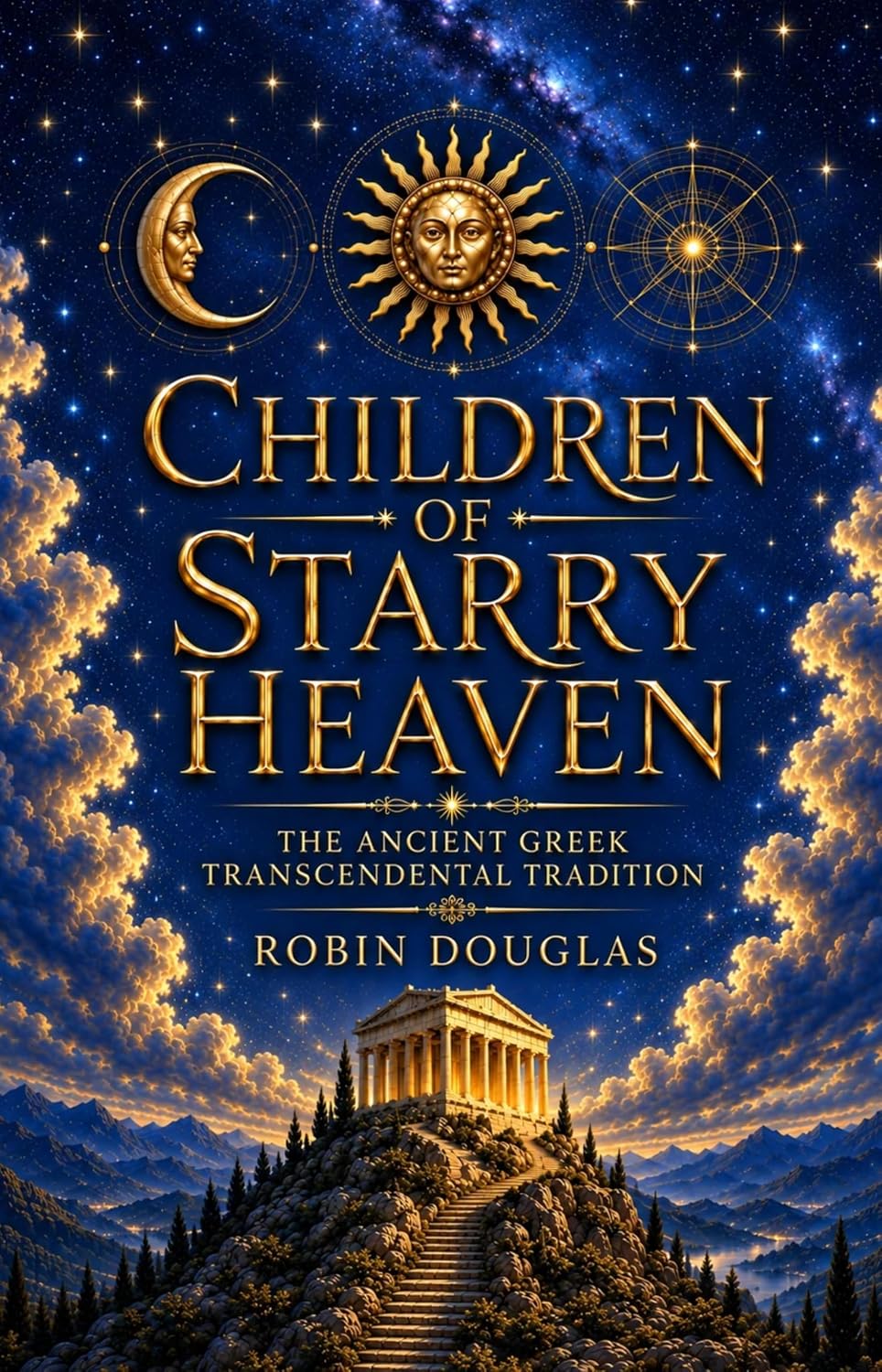
Robin Douglas, Children of Starry Heaven: The Ancient Greek Transcendental Tradition (Cherry Hill Seminary, 2026), 204pp.
There is a great deal published every year on Greek religion, and ever more published on Greek magic; but there was, of course, a middle ground between public religion and transgressive magic in the ancient world. What we choose to call that middle ground will vary – occultism, perhaps, or esotericism; or, in the context of the ancient world, we often encounter the term ‘mystery religions’. The term Robin Douglas opts for in Children of Starry Heaven, ‘the transcendental tradition’ avoids the implicitly confessional character of ‘mystery religions’, as well as doing something to evade the anachronism of ‘occultism’ or ‘esotericism’. It is a term flexible enough to be applied both to traditions of belief that expressed themselves in the form of cults and to strands of thinking that might or might not have a cultic outworking. For this is always the difficulty with the history of religion and belief in the ancient world – our familiar categories are difficult to apply to the pre-Christian world. Nevertheless, what Robin Douglas describes in Children of Starry Heaven was a real and distinct phenomenon of the ancient world, which has been due a modern history – and Robin Douglas provides this, introducing the mystery traditions of ancient Greece accessibly and comprehensively.
A modern introduction to this field is so badly needed because it is one in which many misconceptions thrive. Much that we know about the ancient Greek transcendental tradition came to light only in the 19th century, thanks to archaeology, and its discovery coincided with a revolution in Biblical studies that tempted many scholars astray into unwise exercises in comparativism. The result is a series of canards that are still hard to dislodge – for instance, that Christianity was just one ‘mystery religion’ among many, and that most of the mystery religions offered pretty much the same thing – a saviour god who was died and reborn, initiation into a saving mystery, and a sense of identity in community. Christianity, on this reading, was just another Greek mystery religion with Jewish vibes. As Douglas demonstrates, the principal reason why this picture cannot be maintained is not because we know Christianity wasn’t a mystery religion, but because in most cases we know very little about any of the mystery religions. Comparison with something we scarcely understand is a dead-end of fallacious reasoning and spurious assumptions.
In the place of jumping the gun by comparing the ancient mystery religions with what came after them, what Robin Douglas proposes in Children of Starry Heaven is a careful analysis of what we do know about the transcendental traditions of ancient Greece. These include Orphism, Pythagoreanism, the mysteries of Eleusis and Isis, Platonism and Neoplatonism, Gnosticism, Hermeticism, and the tradition of theurgy. It should be immediately evident from this list that Douglas does not confine himself to ‘cults’. The study of the ancient transcendental tradition spans the fields of intellectual history and religious studies; Platonism and Neoplatonism cannot be properly understood unless we acknowledge that these belief-systems had religious implications, just as the mystery cults had philosophical outworkings. Sharp distinctions between philosophy and religion (and still less science!) simply do not work in the ancient world.
While Douglas studiously avoids any simplistic comparisons between the ancient mystery traditions and Christianity, he does emphasise (in common with Ronald Hutton) the debt owed by the modern Pagan revival to the Greek transcendental tradition. In the vast majority of cases, when 19th- and 20th-century commentators thought of ‘paganism’ they pictured Dionysian revels rather than the austerity of civic religion. Attempts to revive Paganism as public religion (we might think of Robespierre’s Cult of the Supreme Being) were largely failures – and not only because it was difficult for them to get a foothold in a Christian culture. Greek transcendental traditions were focused on individual spiritual development in a way that suited a minority faith where public expression was largely impossible. For the ancients, of course, it was not fear of opprobrium that drove them into caves, groves and underground temples but a desire to connect ecstatically with the divine. I don’t think this means that civic religion was without its spiritual element; but as any Christian will tell you, corporate worship and private mystical prayer can both be experiences of the divine, but in very different ways. What the ancient world offered was many diverse ways to attain private enlightenment – ways far more diverse than were available to people in subsequent centuries.
Children of Starry Heaven is an indispensable guide to the Greek transcendental tradition – a tradition that, as Douglas notes, can stand comparison with any of the great spiritual traditions of the world but that has often been written off as ‘un-Greek’ – a kind of foreign debasement of the expected purity of Greek religion. In many cases we know little about it (or at least little for sure), but in other cases we are in possession of extensive mystical texts. It is a tradition – or a series of traditions – that will go on to inspire people for a long time to come.

Leave a Reply