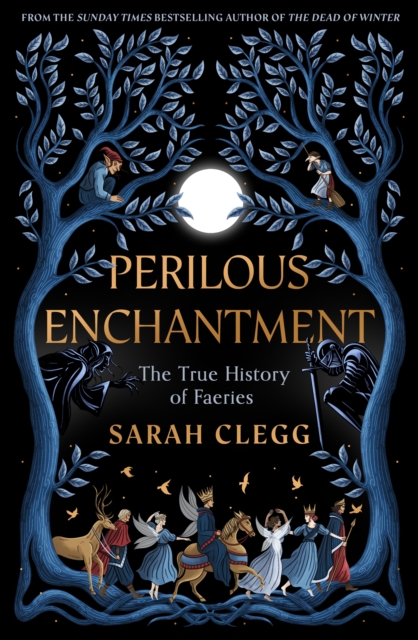
Sarah Clegg, Perilous Enchantment: The True History of Faeries (Granta, 2026), 332pp.
Sarah Clegg’s Perilous Enchantment is the third history of fairies to appear in the last twelve months (if you don’t count Matt King’s A History of Goblins), which is rather remarkable given the long neglect of fairies by publishers. After the death of Katharine Briggs in 1980 scholarship on fairies largely faltered in Britain, although North American scholars such as Peter Narváez and Barbara Rieti kept the flame burning in the 1990s, and Carole Silver’s Strange and Secret Peoples (1998) deserves special mention. Then came Diane Purkiss’s Troublesome Things in 2000, the first attempt at a history of fairies for decades, and the early 2000s saw the reprinting of some of Katharine Briggs’s works. It was encountering one of these, Routledge’s 2002 reprinting of The Fairies in Tradition and Literature (1967) that first had me wondering if fairies could be a theme for the historian. Then the breakthrough came: the publication in early 2018 of Magical Folk by Simon Young and Ceri Houlbrook. The publisher was Granta – now also the publisher of Sarah Clegg’s Perilous Enchantment. Young and Houlbrook’s book was then swiftly followed by Richard Sugg’s history of fairies and, before the end of the year, by my own Suffolk Fairylore.
The process by which histories of fairies have rapidly gone mainstream is one that fascinates me; in 2006, when I first asked myself whether fairies could be a subject for the historian (as opposed to the folklorist), I was almost certain that the answer was ‘no’. There just wasn’t enough to go on. Books like Lewis Spence’s British Fairy Origins (1946) seemed hopelessly outdated, and Briggs had confined herself to cautious speculation when it came to the historical origins of fairy belief – leaving the impression that fairy origins were a black box that was completely dark inside. Alaric Hall’s remarkable book on elves (2009) changed my mind about that, and at long last I reached the point where I felt able to write Twilight of the Godlings (2023), my attempt to tackle the origins of Britain’s fairies.
It is always gratifying to see a question once considered impossible to answer (or even engage with) become a mainstream subject for a popular audience, and to see one’s own work inspire such popularisation. Sarah Clegg’s Perilous Enchantment is a popular, general history of fairy belief that relies extensively on my scholarship as well as that of Diane Purkiss, Richard Firth Green, James Wade, Ronald Hutton and many others. It offers a good and pleasingly broad overview of the subject. After three chapters on deep origins (focussing respectively on Germanic, Celtic and Classical traditions), Clegg gets stuck in to the medieval Romance tradition that is clearly what she finds most interesting, and we have chapters on the fairy court, fairyland and fairy lovers that are heavily inflected by her focus on Romance. Chapters on fairy witches, changelings, domestic fairies and the fairy tale tradition are followed by a chapter exploring contemporary interest in fairies, with a particular focus on the phenomena of Romantasy and fairy roleplay. The book’s final chapter – or coda – reflects on what Simon Young’s Fairy Census might have to tell us about fairy belief today.
Perilous Enchantment has a number of strengths. As a non-specialist, the author is able to offer an overview that few scholars could manage – we are always doomed to get bogged down in our own specialisations (like the constant gravitational pull of the Baltic region in my own work, for example). Clegg’s visits to various fairy-associated sites (and not always predictable ones, either) ground the narrative and lend it atmosphere. Her knowledge of and feel for the medieval Romance tradition is excellent. Unfortunately, however, Perilous Enchantment is a book whose strengths are outweighed, in my view, by its shortcomings. The most serious of these is its tone. Glib and flippant footnotes litter the text; perhaps these are intended to impart a chatty tone, perhaps many of Clegg’s readers enjoy them; but they left me with the impression that the history of fairies is not to be taken seriously, and I fail to see what they achieve other than undermining the book’s credibility.
The centrality of medieval Romance literature to the book begs a question the author never truly confronts head-on – a question that every author of a history of fairies must grapple with. Fairies exist both in literature and folklore, and therefore a historian of fairies must decide if their primary focus is folkloric or cultural. Diane Purkiss chose the latter course, I chose the former, but Sarah Clegg seems unwilling to make a choice. The choice is acute when it comes to Romance because, as James Wade observes, we simply do not know if the fairies of Romance bore any relation to folklore at all. That they informed folklore has been argued convincingly by Hutton, and Clegg leans into that argument – but on the question of where the fairies of Romance came from in the first place, Clegg states that authors ‘turned to the folklore of Brittany for their inspiration’ (p. 92). This may be true, but it is unsupported by the evidence. It is the reason why I devoted scant attention to Romance in my history of fairies as a folkloric phenomenon. We do not know that Romance fairies emerged from folklore, received literary elaboration, and were then absorbed back into it – which is how Clegg tells the story.
Furthermore, Clegg takes Hutton’s argument that the Romances changed the way people saw fairies (an argument about which I have some reservations – see Twilight of the Godlings) and pushes it further than Hutton ever did, arguing that ‘The only truth of these creatures is the stories we tell about them – inevitably, when we change the stories, it changes the creatures themselves’ (p. 109). Clegg tells us that folklorists call this ostension – but ostension does not require us to think ‘the only truth’ is story. Hutton was arguing that the way fairies were represented was transformed by conventions of Romance filtering down to ordinary people; he did not say there was no truth beyond such stories. It is here I part company with Sarah Clegg: in her assumption that fairies should not be treated as part of reality, but only as beings of story. If this is true, how are we to make sense of the extraordinary claims people made about fairies? How are we to make sense of the agency and power that fairies seemingly exerted? Were people in the past simply very gullible? Were they making it all up? Were they hallucinating? Was it all a way of justifying adultery, extramarital sex and infanticide? Or did people in the past have much more active imaginations than we do?
Some or all of these things may be true, but Sarah Clegg’s narrative is torn between fascination with (even admiration for) fairy belief and an equal insistence on its unreality. This tension is most in evidence in the chapter on ‘fairy witches’. Here she reminds us that the inquisitors who investigated fairy beliefs were not the ‘experts’ they claimed to be, because ‘I feel that to be an expert, the very least you need to acknowledge is that it’s all made up’ (p. 172). She suggests that Isobel Gowdie only said what she did under torture, for which there’s no evidence (and both Emma Wilby and Julian Goodare argue for a spontaneous confession), and while wanting to portray all confessions of fairy experiences as the confessions of desperate people dredging up fragments of old folklore, she doesn’t explain why people would have made elaborate confessions that went far beyond what their persecutors wanted, and did nothing to help the cause of the accused. Why did Catarina Calandrino confess to a same-sex affair with the fairy Octaviana, unless in some sense this was her real experience? The unwritten subtext seems to be that we are to expect very peculiar behaviour from people in the past because they experienced belief so differently from us, even though none of this stuff was real. But if this is so, why were people in the past so different? What was going on? How did they perceive reality, and why? These are important questions, but Clegg makes no attempt to engage with them.
Likewise, when discussing the absence of threatening fairies from Marjorie Johnson’s collection of fairy encounters, Clegg is very clear that reported fairy experiences were ‘closely mapping the cultural representations of the time’ (p. 296) – what, then, was going on here? Were Johnson’s correspondents all fantasists, liars and hallucinators? Are we supposed to think this question unimportant? In the end, Clegg’s fairies are beings of story: ‘throughout history, fairies have happily adopted the well-told, appealing, interesting stories that fit with both their own nature and what people needed of them at the time’. She observes that ‘There’s still enough of the Romantics in all of us that we yearn for stories … which could, if looked at from the right angle, almost be real’ (p. 300). She urges us to become participants in the fairy tradition and to tell our own stories, since ‘after all, someday someone might believe in them’ (p. 301). What is left unanswered is why some people believe in fairies and why others (such as Sarah Clegg and, presumably, the readers who enjoy her glib style) do not. Are the believers ignorant? Are they silly? Are they children? Are they insufficiently sophisticated? Who are these people who keep practising ostension and bringing fairies out of story into their own experience, and why?
Clegg is right, of course, that fairies are beings of story, and their history can be told as the tale of a literary theme. But the disturbing reality remains that fairies broke into people’s lives and into their experience of reality and made them do things that cannot be explained in any simple way. Story and belief are not enough to account for the unexplained phenomena and extraordinary testimonies that litter the history of fairies. I don’t ask Sarah Clegg or any other author to believe in fairies, of course – but I do ask them to treat the question of fairies’ existence as real beings seriously. Because Perilous Enchantment lacks that seriousness – that willingness to engage with people’s lived experience with the respect it deserves – it ends up disenchanting the very history it claims to enchant.

Leave a Reply