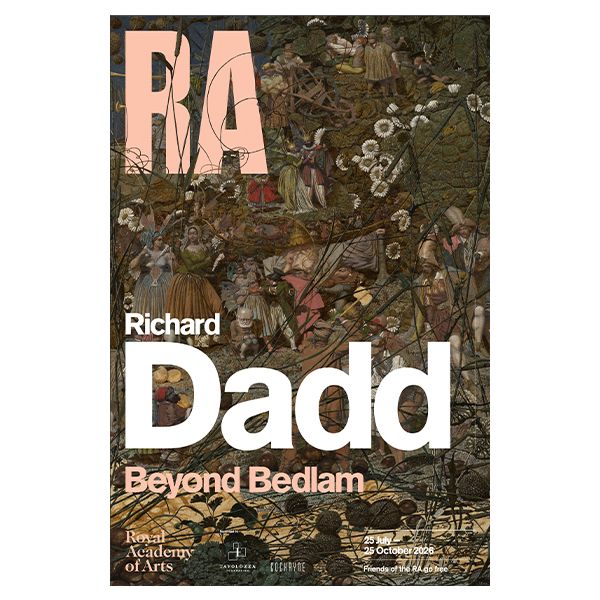
The Royal Academy’s exhibition on the painter Richard Dadd (1817–1886) runs until 25 October, so there is still time to see it. Dadd is most famous as a fairy painter, as well as for being confined to Bedlam and Broadmoor after killing his father in 1843. This occurred after Dadd’s return to England from a tour of Egypt, where he came to believe he had been possessed by the god Osiris while travelling up the Nile. However, Dadd was already interested in the spirit-world before this breakdown; several of the fairy paintings in the exhibition, such as Titania Sleeping and Puck, along with Evening and The Haunt of the Fairies (all 1841) pre-date his confinement to asylums, as does Come Unto These Yellow Sands (1842). As their titles suggest, most of these paintings were loosely inspired by Shakespeare, but they also have the capacity to stand alone as evocations of the fairy world.
The pre-asylum paintings are notable for the contrast between beautiful nude or semi-nude (mostly female) figures and the (much smaller) grotesque goblin-like figures who attend them – in the case of Titania Sleeping, the latter form a kind of living arch over the Fairy Queen that is surely one of Dadd’s most unsettling creations. The pre-asylum paintings also make use of moonlight and dawn and dusk light to create atmospheric and evocative depictions of secret fairy revels, like the fairies who dance around the uncanny Puck, squatting on a toadstool in the form of a proportionally over-sized (yet rather evil-faced) infant. Dadd seems to have been captivated by extreme contrasts of large and small, beautiful and grotesque – which are, of course, a feature of fairy folklore but had also been exemplified in earlier depictions of Shakespeare’s fairies (such as Joshua Reynolds’ famous Puck of 1789, and the fairy paintings of Henry Fuseli). Dadd, however, took the grotesqueness of fairies to a new level.
Dadd’s two greatest fairy paintings, Contradiction, Oberon and Titania (1854–58) and The Fairy Feller’s Master Stroke (1855–64) date from his period of incarceration, and mark a departure from his earlier work. Dadd’s physicians encouraged him to continue painting, and he was notably lucid when talking about art – even if he remained convinced that inspiration was a matter of literal possession by genii and daemons, a view that Victorian mad doctors would have dismissed as insanity. One reason I wanted to visit the Dadd exhibition is that I have never found a reproduction do justice to The Fairy Feller’s Master Stroke, a painting so baffling and overwhelming that it is hard to believe it even is a painting. Seeing it in person is certainly the right decision; it starts, jewel-like, from the canvas, the texture lending depth to a painting notably resistant to depth of perspective (everything seems to be simultaneously in mid-perspective). Gone is the earlier fascination with light and with shade (the same flat light falls upon everything) to be replaced by a mania for intricacy and the multiplication of fairy faces.
There is a reason why The Fairy Feller’s Master Stroke is considered Dadd’s greatest fairy painting. On the face of it, it is another Shakespeare-inspired piece, but in reality it is wholly the product of Dadd’s lurid imagination. Its faithfulness to botanical detail is intense, and the blades of grass in the foreground that almost hide the scene from view render the viewer a participant – as if we are the ones parting the long grass and glimpsing the impossible scene in the undergrowth, among the daisies. The fairies themselves are by turns beautiful and grotesque, familiar and strange – some of them wear recognisable costumes – mid-Victorian hooped skirts, agricultural labourers’ smocks, top hats, a military uniform. They mirror and mock us, but they are not us – their faces often distended and distorted, closer to Bosch than to Reynolds. The painting is crowded, busy, militating against clarity of narrative – even if Shakespeare gives us the clue to what is happening here (the making of a new carriage for the Fairy Queen, from a hewn hazelnut).
In his mature fairy paintings, which were seldom exhibited because he was confined to asylums, Dadd moved from the residual Classicism of his earlier work towards something much stranger and sui generis. This was a kind of ‘fractal miniaturism’, where for every fairy in his pictures there is always one that is smaller. In Contradiction, Oberon and Titania, for example, tiny fairy armies move among the leaf litter at the feet of the main protagonists, while even tinier fairies fly among them; everywhere, it seems, there is always a tinier face, and one even stares out from a single water droplet on a leaf. Dadd’s world is one totally, irrepressibly, maddeningly alive – as if his mental state opened to him a wholly vital universe in which consciousness (signalled by the fairies) permeates everything.
The authors of the exhibition catalogue note various past attempts to make sense of the Victorian obsession with fairy painting via the Victorians’ need to make sense of bodies (in an indirect way) and a more recent theory that fairy painting somehow processed Victorian discomfort with otherness. But Dadd’s images surely defy such functionalist efforts to account for fairy painting as somehow allegorical or allusive. There is, in my view, nothing allegorical or allusive about Dadd’s portrayal of fairies; in common with many people confined to Victorian asylums (as Owen Davies has documented in his book Troubled by Faith, for example) Dadd experienced fairies. Unusually, he had the skills to paint them, but his experience was surely of a fairy-haunted world, both inspiring and maddening. Richard Dadd painted fairies from the life.
One painting that perhaps offers a clue to Dadd’s agenda as an artist is his Bacchanalian Scene of 1862 – not, ostensibly, a fairy painting as such, but a depiction of Bacchic revellers, one of whom drinks from a poisoned cup marked by winged skulls. As in The Fairy Feller’s Master Stroke, we see the faces of the non-human satyrs and nymph through parted foliage; but the most striking feature of the painting is the complete absence of background: faces, slightly distorted and teetering between the beautiful and the grotesque (to indicate their almost-human nature), fill the entire canvas with no relief provided except by the foreground foliage. Dadd’s world is one filled with life – overwhelmed with life – a universe wholly alive with non-human persons. It was a mode of perception that may have driven him mad, although whether he was mad to see the world in such a way is another question entirely. In any case, Richard Dadd Beyond Bedlam is well worth seeing – catch it while you still can.

Leave a comment