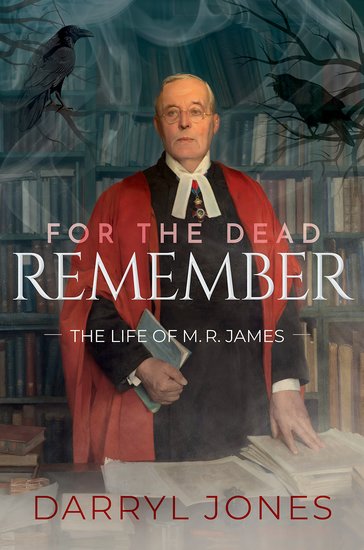
Darryl Jones, For the Dead Remember: The Life of M. R. James (Oxford University Press, 2026), 437pp.
M. R. James did not make it easy for anyone to write his biography. He introduced this difficulty not by keeping poor records, nor by ordering the posthumous burning of his papers (he did; it was ignored), but by pursuing interests so abstruse and hard to grasp that no single person, however scholarly, could ever be fitted to document his life with complete faithfulness. This was proved by Richard Pfaff, whose 1980 biography dealt with James the scholar and wholly omitted any discussion of the one thing M. R. James is actually known for by the public at large – his ghost stories. This is the first decision faced by any biographer of James: do you approach him first and foremost as one of the great writers in the English language, the supreme master of a genre? Or do you approach him as one of the greatest scholars of the early twentieth century, who transformed attitudes to medieval architecture and manuscripts? While I have a good deal of sympathy for Pfaff’s bloody-minded insistence on treating James as a scholar only, it is self-evident that most people approach James as a writer of ghost stories, and therefore it is undeniable that a biography was needed that examines James as a literary figure. Darryl Jones, a professor of literature, has now delivered that biography, and it is a book beyond reproach in its level of detail and attention to primary sources. It has been a long time coming, and eagerly awaited by many, and in this year of the 90th anniversary of James’s death, it does justice to the man and does not disappoint.
Of course, every biographer will have their own distinctive emphasis in approaching someone’s life, and their characteristic interests, and in the case of Darryl Jones those interests are different from mine. M. R. James has loomed large in my own scholarly life, not least because our scholarly lives began in the same place: James’s very first article concerned a manuscript fragment he found in the parish library of St James’s Church in Bury St Edmunds, and it was with fragments from that same library (by then relocated to the Bury branch of the Suffolk Record Office) that my own journey into history and palaeography also began. I am interested in how Suffolk, and specifically the haunting presence of the Abbey of Bury St Edmunds, informed James’s antiquarian interests – a local perspective that does not loom large in Jones’s biography. But I know that I would be a hopeless biographer of M. R. James because, although I share almost all of Monty’s own interests, I am utterly baffled by the late Victorian and early twentieth-century world that he actually lived in; and Darryl Jones’s most significant achievement is perhaps this – that he paints a picture of MRJ as a real person who lived at a specific moment in time, not just a towering giant of antiquarianism and manuscript studies who existed ‘out of time’.
James himself, of course, would have wanted to think he existed out of time; he was not interested in modernity, at least not academically. He was a very peculiar sort of outsider because he was, on paper, the ultimate insider – impossibly clubbable, impossibly credentialled, impossibly eminent and garlanded. He was likewise, on paper, deeply conventional – conventional in his piety, conventional in his theology, conventional in his politics, conventional in his attitudes, conventional in his mastery of the subjects in which Eton and Cambridge trained him so well. Indeed, he was so conventional as to stand out as peculiarly unflappable in a late nineteenth-century cultural context where some degree of existential doubt was becoming commonplace. But James was also profoundly out of step with his own time; as Jones acknowledges, his conscious self-identification as an antiquarian located him within the intellectual frameworks of the seventeenth century, not the nineteenth. Yet James was as far as it is possible to get from an intellectual poser or cosplayer. His antiquarian identity was not an affectation: he genuinely was the last of the great early modern antiquarians, somehow shipwrecked in late Victorian and Edwardian England, and he really does measure up meaningfully to a Scaliger or a Mabillon.
Because James defied convention in ways so different from the usual pattern of rebellion in his time, his brand of defiance went practically unnoticed. His cultivation of an interest in magic and the occult defied utterly the prevailing materialism and reductivism of his era; his interest in the grotesqueries of the Apocrypha defied utterly the simplistic ‘muscular Christianity’ he was trained in at Temple Grove and Eton; and, crucially, his obsession with the Middle Ages defied utterly the implicit ideological assumption of Classics that the ancient world – not the medieval! – provided the highest pattern of human achievement. The skin-deep Gothicism of late Victorian England was supposed to synthesise the aesthetics of the Middle Ages with the achievements and disenchantment of modernity – you weren’t supposed to actually bring back the imps and sprites. James transgressed this unspoken rule; he became too authentically immersed in the Middle Ages for comfort, and the ghost stories are the literary embodiment of the resulting queasiness.
Jones is surely right that James was a difficult person – difficult to write about, difficult to pin down, but also someone difficult to reconcile to the norms and expectations of the present. The biography is much preoccupied with James’s ‘repressed’ sexuality and delves into James’s rather unattractive political views, which come across at times as affected and performatively reactionary. James the immature, overgrown schoolboy, James the incorrigibly institutionalised misogynist (there was no doubt he was a heartfelt misogynist, even by the standards of his time) with a lingering hint of a bully, is not an attractive character. On the other hand, I do have some sympathy with James’s hatred of ‘thought’ – by which he meant expansive theorising and philosophy – as I know from experience that speculative reasoning can sometimes be the enemy of determined attention to detail in antiquarian pursuits.
One slight misstep in the book, I think, is Jones’s analysis of why James never took holy orders. It is a fascinating question: James was noticeably devout and doctrinally orthodox by the standards of his time, and held two senior ecclesiastical appointments then customarily reserved for clerics (Provost of King’s and Provost of Eton), so why did he not become one? Jones rightly dismisses suggestions that James somehow dissembled his real beliefs, but he speculates that James may have nonetheless harboured a fear of being tempted to ‘resign all religious and moral sanctions’. Jones may be right about this, but it is plain to me that James was intimidated by his parents’ intense evangelical religiosity, to which he clearly did not measure up. By the standards of his time, James was eminently suited to the clerical life; but he was the son of an evangelical clergyman, from a family with a strong evangelical tradition, and had he taken orders he would have been expected to follow suit. Given this personal context, James surely knew that his quiet and restrained religiosity would not have been enough. His father and mother would surely have expected him to take a living, not to remain at King’s as a merely nominal cleric. By not being ordained, James ensured he had the freedom to pursue his arcane studies, for the simple reason that he was unqualified to do anything else.
James’s decision to supplicate for the (then brand new) degree of Doctor of Letters in 1894, rather than the traditional degree of Doctor of Divinity, is also an important clue; as a lecturer in divinity and an authority on the Apocrypha, James was eminently qualified for the more senior degree of DD. But he avoided it, for the same reason as holy orders – because nothing mattered more to Monty James than absolute freedom to pursue whatever ‘weird erudition’ took his fancy. In this respect he was both very old-fashioned, and very modern – like a cross between a dilletante antiquarian of the seventeenth century and a chaotically experimental scholar of the later twentieth century. For all his conventionality, he defied one of the most powerful conventions of all and refused to identify himself with any established discipline, opting instead for a ‘flamboyantly irrelevant’ scholarly course.
One question that intrigues me about James is why he was anti-Catholic – banning a performance of The Dream of Gerontius from King’s in 1909, for example, as ‘too papistical’. As Jones astutely observes, James’s lifelong opposition to the reconstruction and restoration (as opposed to conservation) of churches emerged from his religious background and convictions. He was not just a performative reactionary in this regard (as some churchmen were in their anti-Catholicism in the late nineteenth century), but also seems to have regarded the revivification of the medieval world as suspect. This is deeply paradoxical, of course – James was a man who spent his life immersed in the manuscript remains of the Middle Ages, trying earnestly to understand it on its own terms, almost to the point of waking the dead – and he lived a quasi-monastic life within great medieval institutions. So how could someone who loved the Middle Ages so deeply be so wary of Catholicism? The answer, I suspect, is the same reason James preached wariness of the dead in his ghost stories. It is the proper place of the dead to stay dead – religions as well as people – but as both the burgeoning Anglo-Catholicism and the burgeoning occultism of his era demonstrated, dead things would not always stay dead if people were sufficiently determined to reanimate them. Perhaps it was Arthur Machen’s Anglo-Catholicism that left a nasty taste in M. R. James’s mouth (‘Rather a foul mind, I think’) when he read his stories. Like the badly restored churches that MRJ deplored, when things returned from the dead they often turned out to be unwelcome monsters. Thus, quieta non movere.
Jones is generous in his evaluation of M. R. James’s wartime record. MRJ was Vice-Chancellor of Cambridge at the outbreak of World War One, and thus one of the nation’s most important educational figures at that historical moment. He immediately opened the university to academic refugees from Belgium and elsewhere, incurring the lasting thanks of the Belgian church and state. His biographer is less complimentary about James’s attack on the comparative mythology of Jane Harrison; and while James was undoubtedly misogynistic in his language (as he always was), I cannot agree with Darryl Jones that this dispute was an unfortunate blot on James’s career. This is for the simple reason that James was right, and Harrison was wrong. Comparative mythology is mostly complete rot, as subsequent scholarship has demonstrated. Indeed, my experience is that Monty’s considered scholarly judgement is still very seldom wrong, even ninety years after death, and woe betide anyone who was on the sharp end of that judgement (a rare instance where his judgement erred was in accepting Margaret Murray’s argument for the reality of a ‘witch-cult’ as a religion in medieval Europe).
I find M. R. James a perennially fascinating figure, and For the Dead Remember is (finally!) a book that satisfies my curiosity about his life. It is an addictive and compelling read, partly because it is well written but mainly because Monty is so interesting – at least to me. The level of detail is unprecedented, even if much of it concerns the rather dry details of James’s administrative responsibilities. But James’s institutionalism was a key aspect of the man – he lived his life through institutions. Darryl Jones, on the whole, avoids the mistake made by some would-be biographers of James who obsess over the dark psychology that may or may not have birthed them, without truly making the effort to understand the details of James’s life. Jones, by contrast, meticulously traces the hints of inspiration James may have received from his friends, his travels, his studies and the course of events. But M. R. James was first and foremost an antiquarian; the last of the great antiquarians. The eclecticism was the point, and the ghost stories were part of that eclecticism. In my view, the stories were a kind of epiphenomenon of antiquarian research – a way of expressing, in literary form, feelings arising from the uncanniness of being in the business of continually resurrecting the past; feelings that could not be expressed (obviously) in texts such as the manuscript catalogues into which James poured so many hours. James’s stories are the best, because his acquaintance with the uncanniness of the past was the deepest; they are the best because he was, without any exaggeration, the greatest of scholars.

Leave a comment