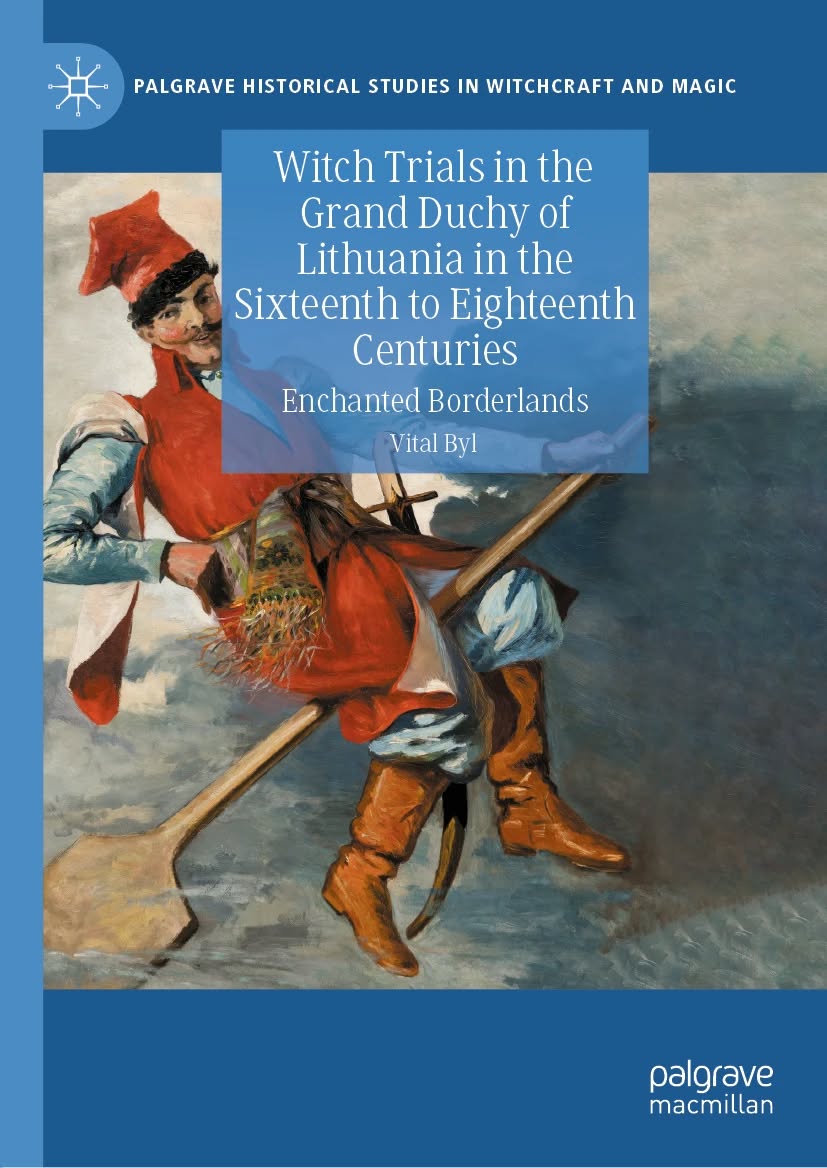
Vital Byl, Witch Trials in the Grand Duchy of Lithuania in the Sixteenth to Eighteenth Centuries: Enchanted Borderlands (Palgrave MacMillan, 2026), 295pp.
Few European regions have been more neglected in the study of witch trials than the Grand Duchy of Lithuania, yet the legal status of witchcraft in the Grand Duchy opens a very interesting window on Lithuania’s strange status as a borderland between east and west in the early modern period. The Grand Duchy was, at least officially, a Catholic country that looked westward to the Latin rite world; yet its population was majority Orthodox and most of them spoke the ancestor of today’s Belarusian language. Similarly, the legal system of the Grand Duchy had both western and eastern elements – as did its demonology when it came to the spirit-world. On the one hand, Lithuania came under the influence of an East Slavic approach to sorcery and magic which treated such matters as canonical infractions deriving from superstition or diabolical delusion; but on the other, Lithuania was also part of the Polish-Lithuanian Commonwealth (and part of Latin Christendom) where elaborate demonological ideas about witches and witchcraft circulated – and where witchcraft was a capital crime deserving of death. It was the latter approach that won out in the 1588 Statute of Lithuania where witchcraft was a matter for the secular courts (much to the church’s chagrin) and was punishable by burning.
Vital Byl’s study of witch trials in the Grand Duchy of Lithuania provides, for the first time, a complete study of the procedure, outcomes, and underlying beliefs behind the witch trials in this corner of Europe – a significant feat, since the secondary literature on the subject is in three languages (Polish, Lithuanian and Russian). Byl shows that early modern Lithuania’s judicial system was highly fragmented, with Magdeburg Law often applying in urban areas where the judicial system was different from what prevailed in the countryside – where landowners often presided over their own courts. In addition, there was a Grand Ducal court supreme over all of these where justice was meted out to the nobility. Byl sets out to explain why witch trials were so marginal, occurring at a lower level in Lithuania than almost anywhere else in Europe where witchcraft was prosecuted. He concludes that the fragmented justice system ensured that accusations of witchcraft remained very local and were dealt with at an individual level (although occasionally ‘chains’ of accusations did occur), while the nobility seldom accused one another of witchcraft – perhaps because the patrician democracy of the Grand Duchy offered plenty of other outlets for resolving and perpetuating conflicts. The absence of a tradition of significantly fearing or severely punishing witches in the Orthodox tradition was surely also a factor.
The status and interpretation of witchcraft in the ethnically Lithuanian (and Catholic) northern and northwestern part of the Grand Duchy is of particular interest for the light it can shed on the success of Christianisation among Lithuanian peasants. What is most striking about the relationship between witchcraft accusations and the issue of Christianisation is the apparent absence of a relationship. In spite of the fact that Christianisation was an ongoing process throughout the period of the witch trials in Lithuania, the imagery surrounding witchcraft accusations was wholly conventional, and (with a handful of exceptions) could have been lifted from anywhere in Europe. For instance, accused witches confessed to dealings with devils called ‘Gabriel’ and ‘Pawel’ whose names show no pre-Christian influence whatsoever, and covens of witches were said to be led by Jews, Ruthenians, Germans or Tatars (as generic ‘outsiders’), and never by pagans.
In one case from 1697 a man was accused of witchcraft on the grounds that he was a werewolf (p. 159), which was a distinctively (albeit uniquely) Baltic preoccupation, but only in a couple of cases do we encounter the same sort of elements that are mentioned in the accounts of missionaries seeking to Christianise the Lithuanians. At Kupiškis in 1641 witches were said to have gathered by an old oak tree and at Dirvonėnai in 1696 witches were said to fly to the hill of Šatrija (the ancient sacred place of the Samogitians, the location of their sacred fire), turning into magpies – a bird associated with the Laumės (p. 173). But folkloric elements of this kind are otherwise almost wholly absent. Byl attempts to link the flying incubus known as latawiec to the flying serpent or bird aitvaras (pp. 182–83), but aitvaras is without sexual connotations – here again the witch-lore seems strangely disconnected from folklore.
In discussing the purposes of witchcraft accusations, Byl suggests that one aim may have been to suppress local superstitions (p. 254); but this seems unlikely, as if this was the case then why would the clergy and magistrates not have targeted unchristianised communities? There is no evidence they did. Paganism was never prosecuted as witchcraft in Lithuania, in contrast to Estonia and Scandinavia. There are a number of possible reasons for this. It is possible that adhering to pre-Christian practices among ethnic Lithuanians was so common that it was not sufficiently ‘othering’ to make an accusation of witchcraft plausible. There is also a sense in which ‘pagan’ was not really a meaningful identity in the Grand Duchy; all Lithuanians were, after all, nominally Catholic Christians – and even if they had not been baptised they were deemed Catholics (or potential Catholics) as a group. In other words, a pagan Lithuanian had no separate identity from a Catholic one in early modern Lithuania. It is also likely that the stigmatisation of paganism as witchcraft would have been ineffective because pagans had their own notions of acceptable and unacceptable magic, and Lithuanians who adhered to pre-Christian traditions were as eager as anyone else to prosecute and expel from the community people who engaged in evil magic (such as sorcery involving the bones of the dead).
Whatever the reasons, the consequence of all this is that the prosecution of witchcraft in Lithuania and the trial records seem strangely disconnected both from the parallel process of Christianisation that was ongoing by missionaries at the time and from the folklore of witches collected by 19th-century folklore collectors. However, it is important to recognise that missionaries were sometimes actively opposed to witch-hunting – mission and witch-hunting were not just parallel but also antagonistic activities, since the church wanted to assert its authority over people’s lives and magistrates’ meddling in a spiritual matter hindered that. And it is unsurprising that magistrates and witch-hunters had little interest in folklore – even in western Europe, instances of detailed testimonies going deep into folkloric beliefs (such as the confession of Isobel Gowdie) are rare. In the end, Vital Byl’s book leaves us wondering why witch-hunting and witch-trials happened at all in the Grand Duchy of Lithuania. That is not a reflection on the quality of his scholarship; explaining why the witch trials happened when they did, and why, is a perennial historiographical problem to which no-one has yet produced a satisfactory answer. What matters is that Byl has opened up an almost entirely unmapped treasury of material on the prosecution of witchcraft in East-Central Europe, in a meticulous, thorough and authoritative study of the Grand Duchy of Lithuania.

Leave a Reply