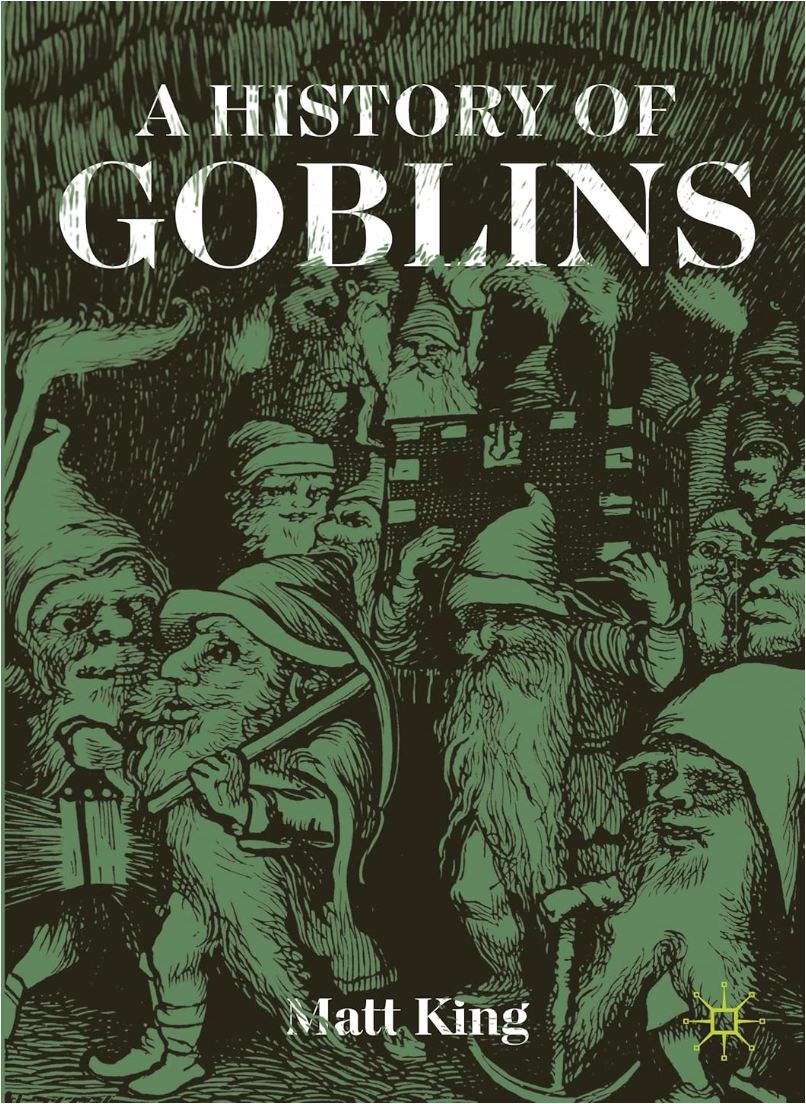
Matt King, A History of Goblins (Palgrave MacMillan, 2026), 450pp.
The last twelve months have seen the publication of several important books on fairies, including Matthias Egeler’s Elves and Fairies: A Short History of the Otherworld, Carolynne Larrington’s Little Book of Fairies, and a reissue of Katharine Briggs’s Dictionary of Fairies, while Jo Hickey-Hall’s Modern Fairy Sightings is scheduled for publication this autumn. Alongside the publication of my own Fairies: A History it seems that fairies are having their cultural and academic moment in the 2020s – much as they had an earlier moment in the 1920s, of course. Matt King’s A History of Goblins is especially interesting insofar as it addresses one specific subset of fairy-like (or fairy-adjacent) beings – meaning that King frees himself, as I have not, from the ‘fairyologist’s’ perennial difficulty in pinning down as semantically fluid a category as ‘fairy’. ‘Goblin’ is not without its semantic difficulties, of course; but it is a word sufficiently distinctive that a history of the lexeme is possible, and this is what Matt King provides. In this respect I would compare King’s book with Simon Young’s superb study of the boggart – a similarly (indeed, even more tightly) restricted lexeme.
Etymology, as I argued in Twilight of the Godlings, is a key source when writing the history of supernatural beings. One reason why it was possible for me to write that book was that scholars like Alaric Hall and Sarah Semple have made considerable strides in etymology that make it easier to trace the origins and development of vernacular supernatural belief. However, like the fairies themselves the etymology of folkloric beings can be very deceitful; we must not make the mistake of presuming that the history of a lexeme is the same as the history of the being to which it corresponds. King understands this, and advances no claim for a conceptually definitive goblin that lurks behind the goblin’s many folkloric and cultural facets; indeed, it is the very changeableness of the goblin that seems to draw this author in. His starting-point is the contemporary resonance of goblins in such cultural phenomena as the ‘Goblincore’ aesthetic and ‘goblin mode’ living, not to mention the ongoing popularity and presence of goblins in fantasy literature, videogames and tabletop gaming. If anything, goblins have a stronger cultural presence (in the adult world, at least) in the modern West than fairies do.
In successfully tracing the history of the word ‘goblin’ Matt King has on his side its fairly late arrival in English, and a limited number of variants – even if it remains unclear if the term should be traced to the Greek kobalos or the Old English cofgodas. I suspect some etymological convergence has taken place, so the ultimate origin of the word is ‘both and’ rather than one or the other. Although the oldest use of the term is as the name of a demon, what is most interesting about goblins (in my view) is their status as the dark side of fairyland – and the fact that goblins, while often diabolical in their behaviour, are not actually demons. Like fairies, they belong to the ‘middle kingdom’ owing to their physicality – with the result that however bad they get, they are still not as bad as the discarnate fallen angels who serve Satan and torment mankind. Goblins’ physicality limits them and constrains their power, and it is perhaps for this reason they have become such popular antagonists in fantasy gaming – the combination of an uncomplicatedly malevolent nature and earthy physicality rendering them ‘eminently killable’, as King puts it. And there has, of course, been inversion of this trope of the unlovable goblin by fantasy authors keen to keep narratives fresh by challenging and inverting expectations.
Matt King’s study ranges widely over medieval and early modern goblins, the use of goblins in colonial discourses, goblins in art and literature, fantasy goblins, tabletop goblins, and contemporary manifestations of goblin aesthetics. The book’s lexical approach allows (unusually for a folkloric study) for a quantitative analysis of the frequency of goblin and hobgoblin references via digital methodologies – not something that would be possible with a term as fluid and ephemeral as ‘fairy’. I am not wholly convinced by the usefulness and validity of such quantitative approaches (there is a lot of room for ambiguity and interpretation that, in my view, only qualitative analysis can illuminate), but they certainly represent as interesting development in the methodologies of folklore studies. Like Diane Purkiss in her study of fairies, King is as much focussed on the goblin as cultural artefact as he is on literal belief in (or experiences of) goblins, but I was gratified to see that people who claim to have encountered or experienced goblins do receive some attention even in the book’s chapter on contemporary goblins.
The dark side of fairies has provoked a lot of interest lately, and goblins are perhaps the definitive ‘scary fairy’ – if they are fairies at all. To my mind they are – I am more of a ‘lumper’ than a ‘splitter’ in my approach to the fairy realm, and I tend to see all supernatural social creatures that are ascribed a physical nature as fairies. Goblins belong to the malign tendency of fairyland – comparable, perhaps, to the trolls of Scandinavia who are more often bad than good. As well as being associated with malignity, goblins are inextricably tied to the grotesque – in contrast to the fairies’ unpredictable oscillation between beauty and ugliness. But as the illustrator Brian Froud well understood, the enchantment of the fairies is often to be found in their very grotesqueness, for uncanniness lies at the root of magical power. Thus it is that while the goblin may seem at first glance the lowest and least enchanted of fairies, in truth there is as much allure in the moss, slime and mud as there is in the glamour of beautiful fairies. Goblins speak to something deep within us that is paradoxically drawn to rather than repelled by the ugly and grotesque – an aspect of our nature that is ever more relevant than ever in a world of doomscrolling and rapt horror at a constant bombardment of online imagery we ‘can’t unsee’. Goblins are embodiments of supernatural and spiritual chaos who, in spite of their tradition of receding into the past, seem to pour out of screens in the present and lurk in our future as our lives are increasingly dominated by goblin-like artificial intelligences over whom we have no control. It is perhaps for these reasons that fairies (and goblins) are having their moment; our present world feels, if not necessarily re-enchanted, then deeply existentially and even ontologically uncertain; we are repeatedly told we should no longer be sure where the human ends and the artificial begins. Understanding the fairy glamours and enchantments of the past has a new urgency, as fairytale, folklore and magic offer some of the few paradigms that are strange enough to enable us to make sense (or perhaps even just cognitively cope with) the weirdness of our present reality.

Leave a comment