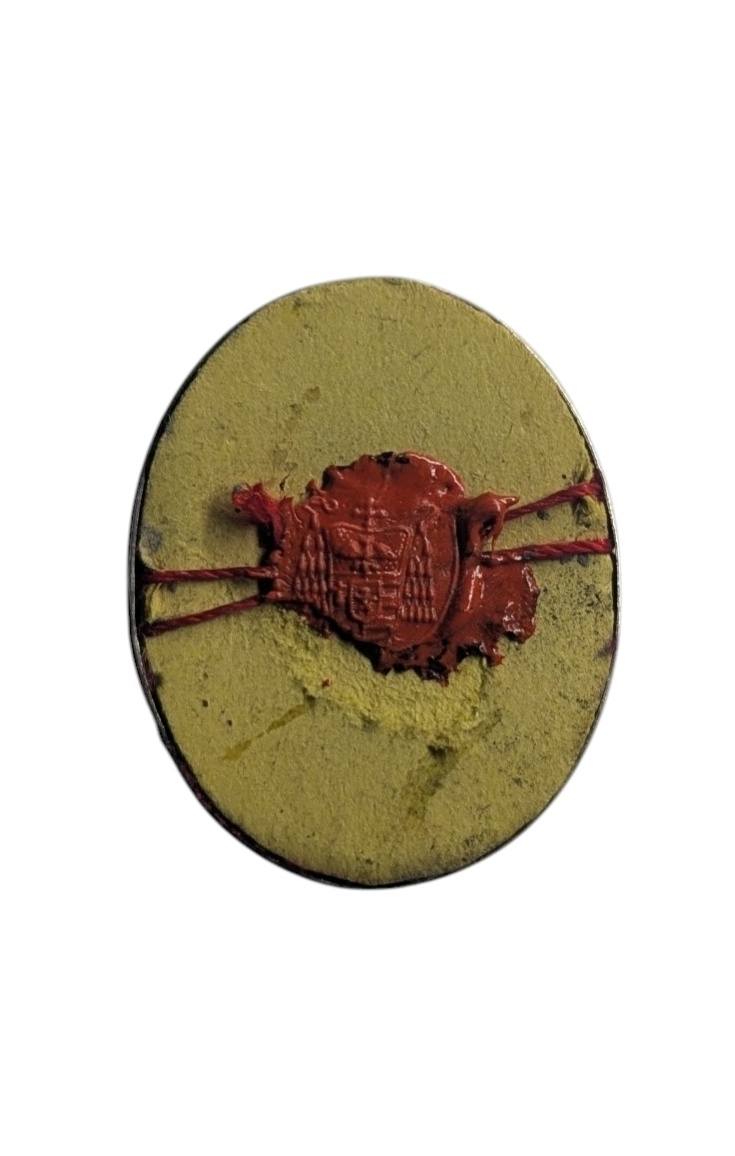
Relics ascribed to St Edmund are rather few and far between, but in 2021 John Brandler donated one (which he had purchased from a French seller) to Moyse’s Hall Museum in Bury St Edmunds. I’ve been advising Moyse’s Hall on their upcoming new exhibition ‘Edmund and the Great Heathen Army’ (indeed, I’ll be speaking on the cult of St Edmund in Scandinavia in an event associated with the exhibition in September), and one question they had for me was whether I could shed any more light on the provenance of the relic (which is a tiny bone fragment enclosed in a locket-like reliquary). The only real clue is the coat of arms stamped on the back of the reliquary by the prelate who authenticated it – which is the coat of arms of a cardinal (judging from the twelve tassels hanging from a heraldic galero). But which cardinal? I was initially led astray by the upper part of the coat of arms, which to my eyes strongly resembled a crown. Only a Cardinal-Prince of the Holy Roman Empire would have a crown or coronet displayed beneath their galero, but my search proved fruitless. It then occurred to me to ignore the heraldry and look for other reliquaries of similar appearance sold at around the same time as the Edmund reliquary, as it was unlikely to have been alone. This led me to find, eventually, a picture of a relic of St Joseph that someone had posted on Facebook which featured a clearer image of the same seal.
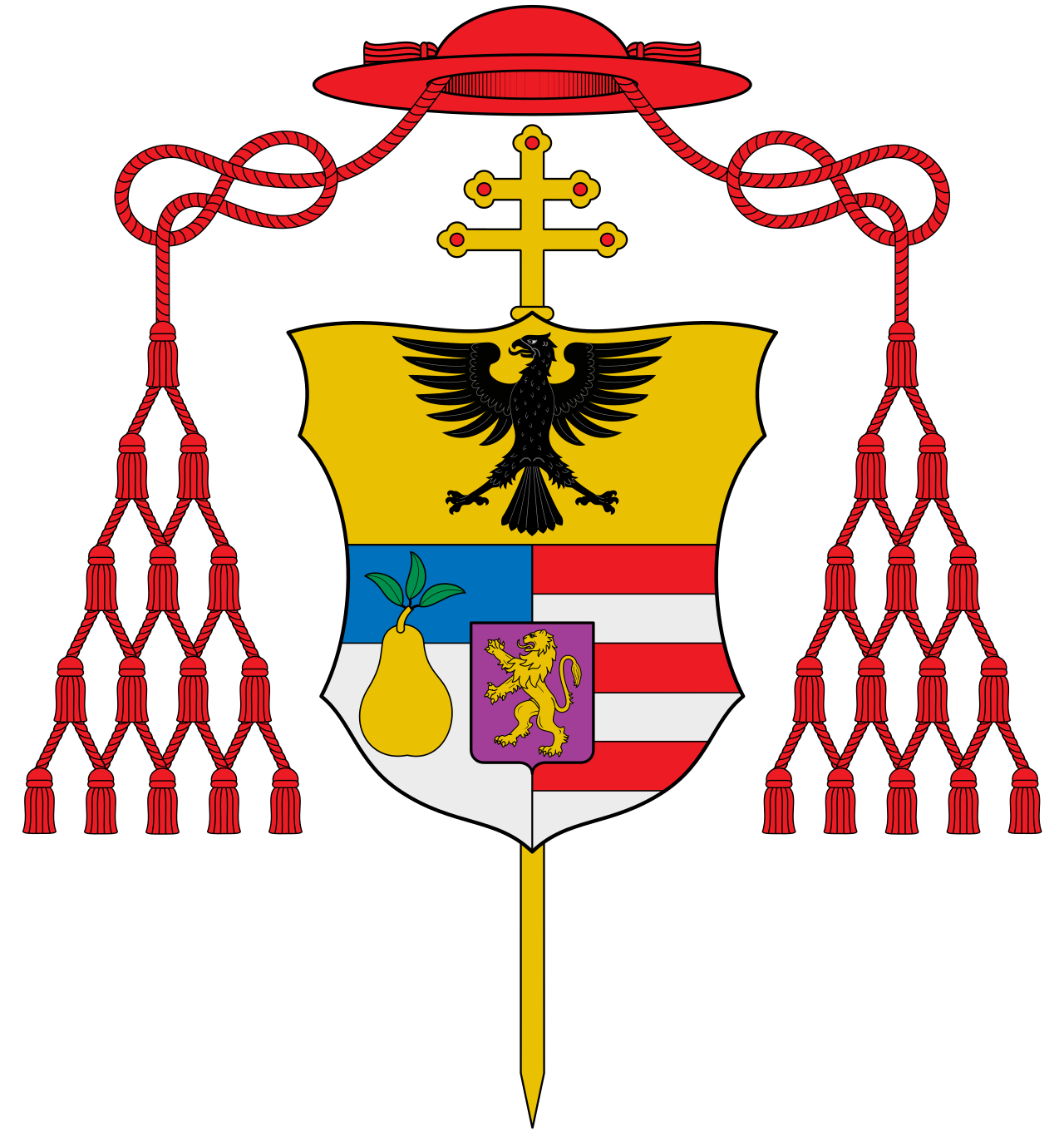
The coat of arms, it turned out, did not feature a crown at all; what I had mistaken for a a cross on a crown was a metropolitan’s cross (indicating an archbishop) and the top of the arms was just a flared portion featuring an eagle. Having a better image of the arms made it possible to identify them as those of Lucido Maria Parocchi (1833-1903), Prefect of the Congregation of the Holy Office – a curial cardinal who was in Rome in 1901, when Pope Leo XIII instructed the Archbishop of Toulouse to hand over the relics at the Basilica of Saint-Sernin said to be those of St Edmund to Cardinal Vaughan. The intent was to install these relics in the high altar of Westminster Cathedral. This never happened (my book about St Edmund gives the whole story), but it did allow a number of alleged relics of St Edmund to escape containment, including several teeth. These relics are not, in fact, St Edmund (again, see my book for all the details), but they represent the only source I know of for alleged relics. The reason I was particularly interested in tracing the provenance of the Brandler relic is that I wanted to establish if, in fact, it belonged to a different source; there are a handful of relics of St Edmund mentioned before 1901 and it would be great to identify one of these.
However, the involvement of Cardinal Parocchi makes it highly likely that, once again, we are dealing with a relic from the usual source, and the seal was in all probability applied in 1901 to a relic taken from the Toulouse assemblage – which Parocchi could verify because he was a curial cardinal at the time Leo XIII gave his approval for the translation of Edmund’s supposed relics to England.

Leave a Reply