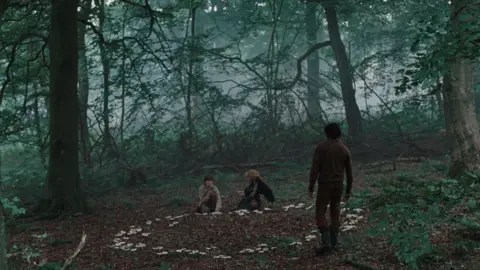
Bryn Chainey’s Rabbit Trap (2025), which has been classified as a psychological horror film (but is in truth just a weird film) is that rare thing: a serious film about fairies. Set in Wales (although notoriously filmed in Yorkshire because the Welsh Government forbids smoking on film sets, making it impossible to make a film set in the 1970s), the film involves the Tylwyth Teg – although exactly how it involves them I shan’t say, in order to avoid spoilers. I will say, however, that Chainey excels by choosing never to let the audience see the Tylwyth Teg; whatever Rabbit Trap is, it is very far from ‘fairysploitation’ horror, like I. N. Shyalaman’s The Watchers (2024). The fairies are there not because fairies are scary, but because Chainey is genuinely interested in fairy lore and wanted to make a film about fairies (his interview with Jo Hickey-Hall is very interesting on this point).
The 1970s setting of Rabbit Trap is surely significant; it strongly echoes films and TV plays of that era with a strong focus on the psychological life of a couple who have gone to live in the countryside, and particularly The Shout (1978). In that film (by Jerzy Sholimowski) a couple living in an isolated cottage in England have a strange and unwelcome stranger insinuate themselves into their life; and John Hurt (like Dev Patel in Rabbit Trap) plays a sound recordist. Both films are preoccupied with the auditory landscape, although The Shout is a darker film than Rabbit Trap (and isn’t about fairies); there is even a memorable cameo from a dead rabbit in the earlier film, and I find it hard to believe that Bryn Chainey wasn’t inspired by it. Be that as it may, a key difference between the two films is that Rabbit Trap wasn’t actually made in the 1970s, and therefore the film’s preoccupation with recorded sound and the analogue equipment used to do so has an added layer of nostalgia (although films in the ’70s itself were sometimes preoccupied with the uncanny potential of sound recording, most notably Nigel Kneale’s The Stone Tape (1972)). I am certainly not the first to notice that the folk horror genre is deeply preoccupied with analogue media (to the point that one recent film, Mark Jenkin’s Enys Men (2022), was even filmed on 16mm); one way to interpret this is that the iconic films of the genre (The Wicker Man, Blood on Satan’s Claw and so on) were all made in the 1970s and therefore a ’70s analogue vibe is part of what makes the genre distinctive. But I think there is a bit more to it than that.
In Rabbit Trap, Darcy is a sound recordist while his wife Daphne is an experimental singer who uses unusual sounds in her recordings (which bring to mind real-world ’70s psychedelic folk bands like The Incredible String Band), and the film dwells lovingly on their analogue recording equipment – tapes, tape recorders, microphones, records, turntables… And if Chainey holds back from showing the fairies on screen, we certainly hear them; the couple’s first encounter with something strange is what they record close to the fairy ring. It is an auditory phenomenon that the Tylwyth Teg first manifest. The contemporary fascination with analogue technology arises, perhaps, from the magic of a technology that could only record what was there; the idea that if you went out with a microphone and a tape recorder in the ’70s you were at a technological frontier where, for the first time, your technology was good enough to record reality as you experienced it – but not yet so sophisticated, and intertwined with other technologies, to be manipulated or faked. In the age of AI and digital everything, a degree of nostalgia for analogue technology as quasi-magical is understandable.
And what of Rabbit Trap’s representation of the fairies? Without giving anything away, the film leaves ambiguous what or who in the film is a fairy, but the film’s principal achievement is to portray human beings under a fairy enchantment. In this emphasis on enchantment it is true to the fairy tradition; the modern notion that fairies are a sort of paranormal fauna or psychic cryptids (perhaps springing from the Cottingley affair) is at odds with the medieval sense that it is the enchantment fairies can cast over experience that matters rather than who the fairies themselves are. Seeing the fairies isn’t important; they are as much a state of being, a mode of perception, as they are identifiable characters.
Rabbit Trap is by no means a perfect film; given the intimate connection between fairies and the land, I have my reservations about transposing the Tylwyth Teg to a landscape that is not theirs (couldn’t the director have substituted Yorkshire’s elves?). And the viewer familiar with 1970s cinema is left at times with an uneasy suspicion of pastiche. But I am not sure this is justified; after all, ’70s cinema never actually tackled fairies, and in doing so Bryn Chainey is attempting something entirely new. There really were people who went into the wilds in the 1970s in search of fairies (Brian Froude and Alan Lee renting a cottage on Dartmoor in order to collaborate on Faeries spring to mind), and the film captures the unsettling moral ambiguity of fairy encounters, which entrap and enchant, but also confront human beings with deep truths about themselves and the earth.

Leave a Reply