
Matt Salusbury, Mystery Animals of Suffolk (Leiston Press, 2023), 348pp.
Many books of local interest, especially books on slightly more left-field topics, tend to be rather slim volumes lacking in critical apparatus, and so Matt Salusbury’s overwhelmingly comprehensive Mystery Animals of Suffolk comes as a pleasant surprise, weighing in at 348 densely packed pages. The book straddles the boundary between folklore and cryptozoology – the field of ‘Forteana’ or ‘anomalistics’, in other words (its author is a veteran writer for the magazine Fortean Times). While Salusbury is broadly sceptical concerning his subject, he also approaches it with a boundless curiosity that is unconstrained by any doubts he may have about the veracity of the reports the book records – and this, perhaps, is the most compelling feature of Mystery Animals of Suffolk. A book that is ostensibly about mysterious big cats and other creatures is, in reality, a book about Suffolk’s people, the strange experiences they have and the unexplained things they see. Mystery Animals of Suffolk is a love letter to the strangeness of Suffolk.
And Suffolk is certainly strange. Salusbury evokes well the particular eeriness of each zone of the county, from the bleak salt marshes of the coast to the sandy Brecks and the agrarian secrets harboured by the taciturn yet eerie central uplands of High Suffolk. Odd things are seen in Suffolk, from the Green Children of Woolpit in the 12th century to the UFOs in Rendlesham Forest in the 1980s. And chief among those odd things, today, are persistent reports of mysterious big cats – puma-, jaguar- or lynx-like felines – that periodically emerge in the local press. A number of years ago, my mother was involved in a ‘puma’ sighting on the Moreton Hall estate just outside Bury St Edmunds, apparently involving multiple witnesses, so I am inclined to take the idea that people really see big cats in Suffolk more seriously than most. The data Matt Salusbury has collected on the sightings is admirably exhaustive, and is accompanied by a plethora of illustrations as well as charming hand-drawn maps which add to the book’s enjoyably bonkers feel (in the best possible sense!). I know Salusbury’s book was bedevilled by delays, meaning that his research lasted for much longer than he expected – but this can be the best thing that can happen to a book, making possible a level of comprehensiveness that might be lacking from a volume prepared to a tight deadline. What Matt Salusbury has provided is a veritable treasure-trove of Forteana and folklore that readers interested in the stranger side of Suffolk will be exploring for years to come.
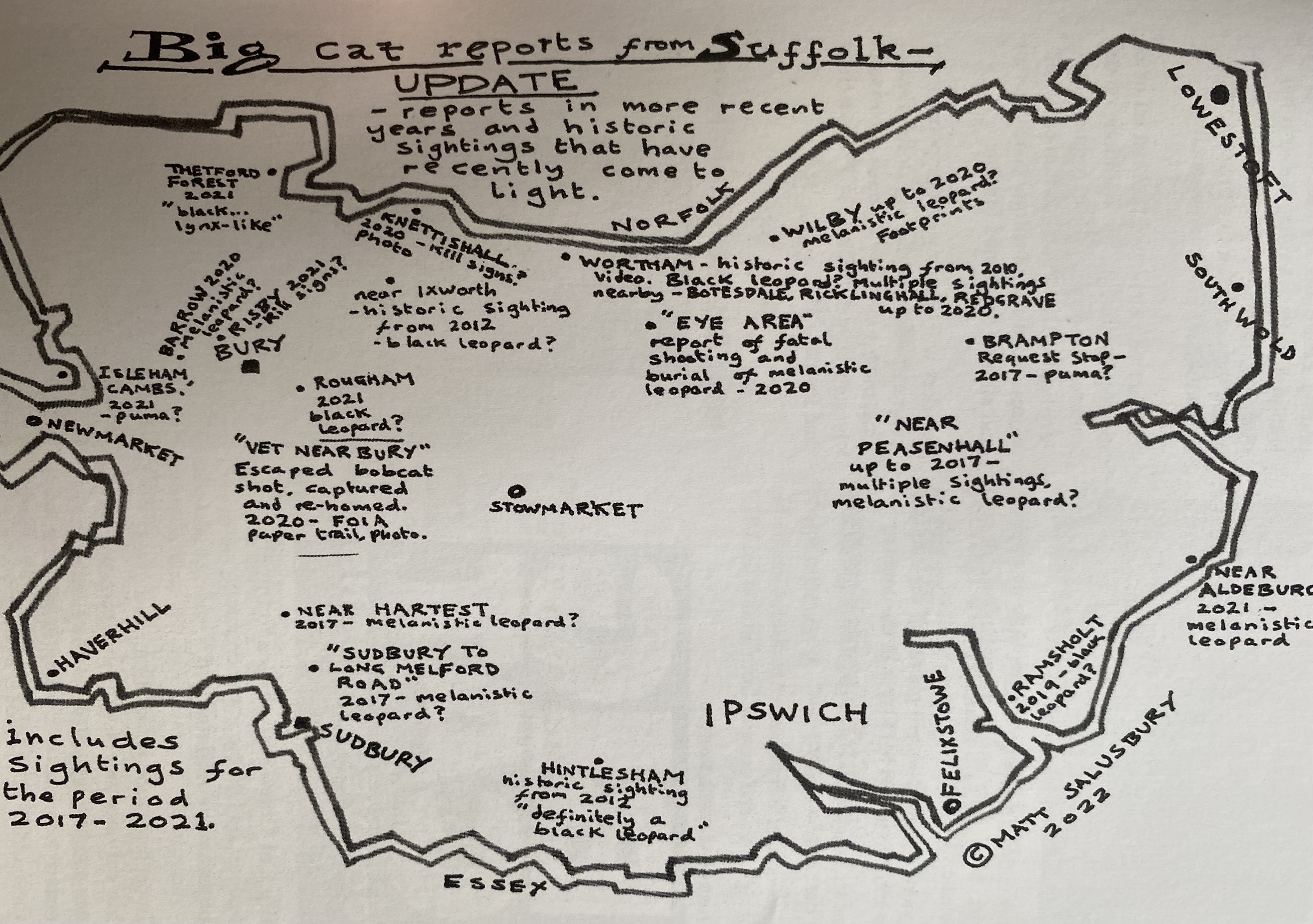
Anyone familiar in the slightest with my own work, however, will know that my own interest is not so much in cryptozoology as in folklore – and Salusbury’s book chiefly excites me because it is not just about big cats and other (presumably) real animals, but also touches on beings of folklore such as woodwoses, dragons, fairies and mermaids. Salusbury himself distinguishes between those beings more likely to be real and those that are clearly folkloric, moving from the legendary to the plausible in the course of the book. While I am not sure I agree with such a sharp distinction, and Salusbury’s eagerness to find explanations for people’s anomalous experiences is alien to my own approach (he attributes many fairy sightings to Charles Bonnet Syndrome, for example), the author also allows even the most outlandish stories to speak for themselves. I was intrigued, for example, to learn of a couple of modern-day woodwose (or ‘British Bigfoot’) encounters in Suffolk (pp. 39-41). We also encounter a ginger werewolf and the dog-headed man of Tuddenham, last spotted in the 1990s (pp. 77-8), while monstrous aquatic creatures such as the ‘Waveney Monster’ of the 1980s (pp. 91-2) also receive due attention.
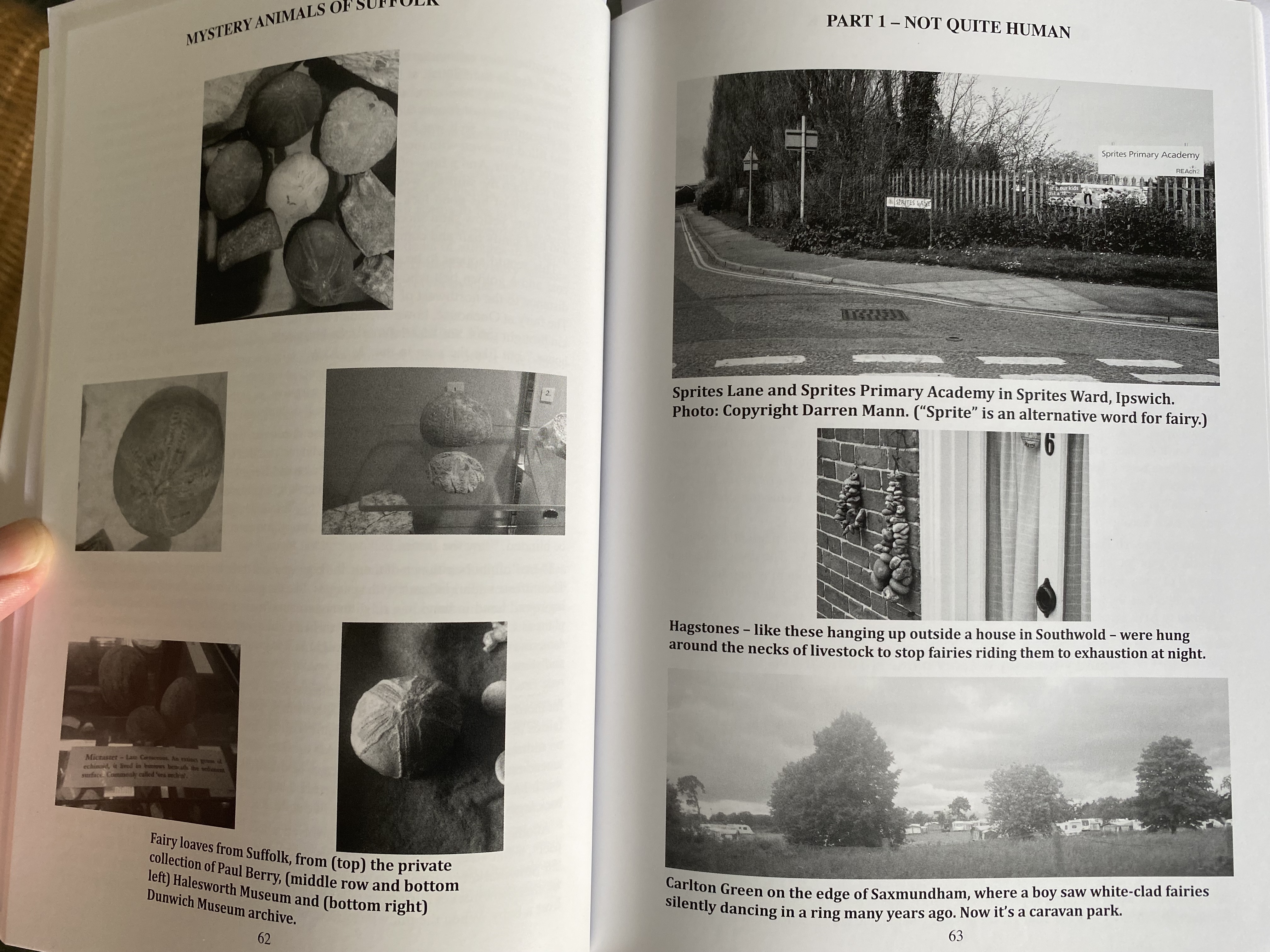
The book’s section on hobby-lights and Jack o’Lanterns shades into UFO lore, recounting encounters with bizarre lights and even suggesting that the Rendlesham Forest Incident could be interpreted in the light of folklore about floating lights (p. 151) – which warms my heart, as someone who always prefers folkloric to ufological or cryptozoological approaches to strange phenomena. However, one of the book’s most important sections is on Shuck (pp. 95-119), providing a suitable ‘conceptual bridge’ between the chapters on folklore in the first half of the book and its later consideration of reports of potentially real out-of-place animals. Shuck is, of course, a black dog – or at least that’s what he usually is, and his shapeshifting abilities shouldn’t be forgotten; but Shuck is very much a feature of folklore and nightmare rather than cryptozoology. Nevertheless, there is a strange parallelism, as many have noticed and Salusbury acknowledges, between the former pattern of sightings of Shuck (‘My dad saw Shuck in the seventies’-type stories, as the author calls them) and more recent sightings of big cats, as if the psychogeography of Suffolk has somewhere undergone a canine-to-feline shift.
Mystery Animals of Suffolk is richly illustrated with photographs of strange creatures on Suffolk’s churches, among other things – a reminder of the rich imagery of the strange that has surrounded Suffolk’s people for many centuries. How many reports of bizarre creatures were inspired by the imagination of medieval stonemasons and carvers? Or how many emerged from young people trying to scare one another silly with tall tales? Salusbury has a sensitive ear to context and, as a seasoned journalist himself, is all too aware of how newspapers treat anomalous phenomena and sightings, and why they report them. This book is an important if unconventional contribution to the literature on Suffolk’s folklore, and especially that most precious of commodities: contemporary folklore. The inclusion of a glossary and a thorough index also make the book accessible and easy to use for the researcher.
Overall, Matt Salusbury’s Mystery Animals of Suffolk is one of the most comprehensive and satisfying explorations of local Forteana published for many years. It’s the sort of book I want to run away with and read again and again on a desert island – or, perhaps, on an eerie Suffolk farm in the middle of nowhere…

Leave a Reply