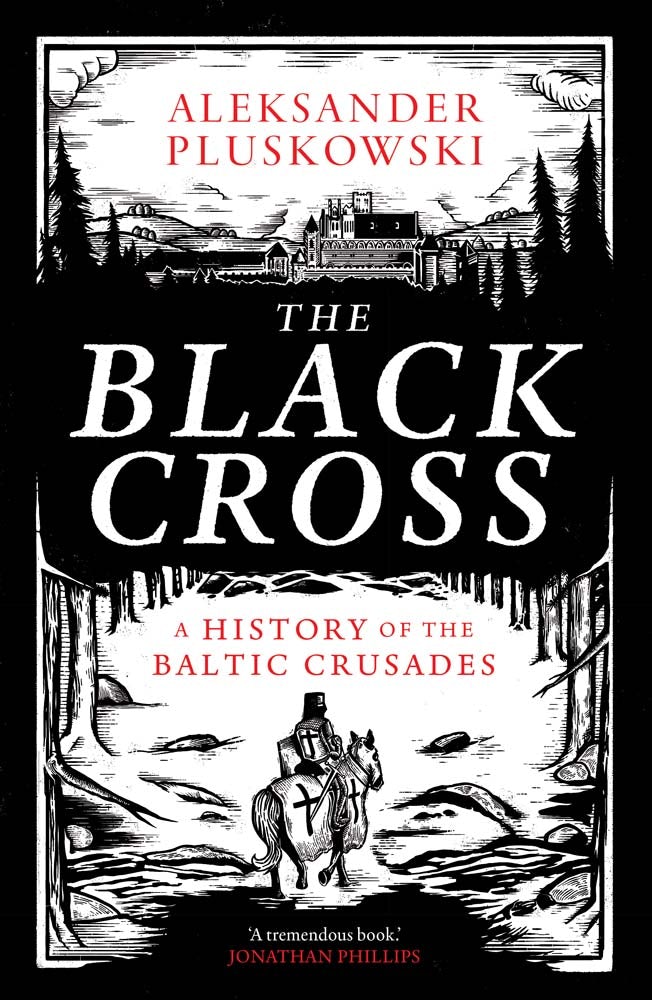
Aleksander Pluskowski, The Black Cross: A History of the Baltic Crusades (Yale University Press, 2026), 447pp.
Aleksander Pluskowki is Professor of Medieval Archaeology at the University of Reading and specialises in the history and material culture of the Baltic Crusades; in The Black Cross he offers an expansive and expert history of this complex subject, beginning with the Wendish Crusade of the 12th century and then considering the conquest of the Livs, Estonians, Latvians and Prussians and the long war against the Grand Duchy of Lithuania. Several histories of the Baltic Crusades suffer from the fault that their authors are principally interested in the subject of crusade rather than in the history of the Baltic region; the crusades in the Baltic are lumped in with the ‘Northern Crusades’ in general or, worse still, simply lumped in with the Levantine Crusades as a northern European footnote. Furthermore, such histories have traditionally been told almost exclusively from the crusaders’ perspective. Pluskowski’s history avoids this; perhaps because he is an archaeologist, his focus is resolutely on the people and communities of the Baltic crusades, and equally on the military orders and the ‘pagans’ they encountered, as well as Christian settlers.
The most charismatic and compelling sources for the Baltic Crusades, famously, are documents produced by the crusaders themselves – like the Chronicle of Henry of Livonia. It is impossible, of course, to avoid relying on such sources, but Pluskowski manages to escape the besetting historical sin of allowing his narrative to be overwhelmed by them, and his decision to accord equal weight to textual and archaeological evidence is a crucial one. As the author acknowledges, the book is as much a cultural history of the Baltic Crusades as a military one – and, indeed, the author’s emphasis is on the periods of peace that punctuated the fighting and on the fascinating two-way cultural interface the Crusade created. As in the Levant, the paradox of a totalising crusade was that (in contrast the usual sporadic character of medieval European warfare) the crusaders created a permanent militarised frontier that inevitably became a source of cultural exchange. The experience of crusading changed everybody: crusaders, clergy, settlers, and indigenous people. I was pleased to see that Pluskowski adopts my interpretation of non-Christian Baltic religion as a religious creole rather than a pristine pre-Christian religion (pp. 271–72) which hopefully marks a shift in the historiography, informed by Silence of the Gods.
The Black Cross is divided into four parts, with the first (‘Holy War in Northern Europe’) introducing the concept of the Northern Crusades and providing the historical background. The second part, ‘Militarised Christianity in the North’, then focusses on the crusaders themselves and the states they built. The third part of the book, ‘Worlds in Transition’, examines the peoples transformed by the Baltic crusades and the worlds created, from the Hanseatic traders of Königsberg, Riga and Reval to the Grand Duchy of Lithuania that ended up being strengthened and unified by the threat of crusade rather than conquered. The book’s final part sets it apart from other histories of the Baltic crusades, as in ‘From Black Cross to Iron Cross’ Pluskowski examines the post-medieval cultural reception of the Baltic crusades and their ideological weaponisation, especially by Germany. However, as Pluskowski argues, in the new Europe that follows the accession of Poland and the Baltic states to NATO a historical reappraisal of the Baltic crusades is taking place. That reappraisal is perhaps best represented by Malbork Castle, whose vast presence opens the book – in a modern, confident Poland Malbork is no longer a troubling symbol of German oppression but a major heritage attraction in a country more willing to confront the complexity of its history.
As Pluskowski notes, the Baltic crusades matter because since the 2000s ‘Baltic history has become recognised as a fundamental part of European history’ (p. 20), and can no longer be written off as peripheral. This is true also from a historiographical perspective; there is an argument to be made that the Ordensstaat of the Teutonic Knights played a key role in the development of the very concept of the state itself, as one of the most structured and centralised polities of medieval Europe – and Pluskowski argues that by establishing a frontier to European Christendom the crusaders helped fashion the very concept of Europe as in some sense a unified Christian civilisation. That frontier may have changed (and, today, Lithuania is very much on the European side of it), but the notion of an embattled Europe menaced from the east is as relevant today as it was in the 12th century. The Baltic crusades are more, therefore, than a blot on European history; in the end, it is important to remember that they failed in their objective of converting Lithuania (which came to the Christian faith by another route entirely), but in the meantime they transformed the landscape of the eastern Baltic littoral and contributed to the creation of many of the geopolitical and cultural realities that prevail in the region to this day.

Leave a comment