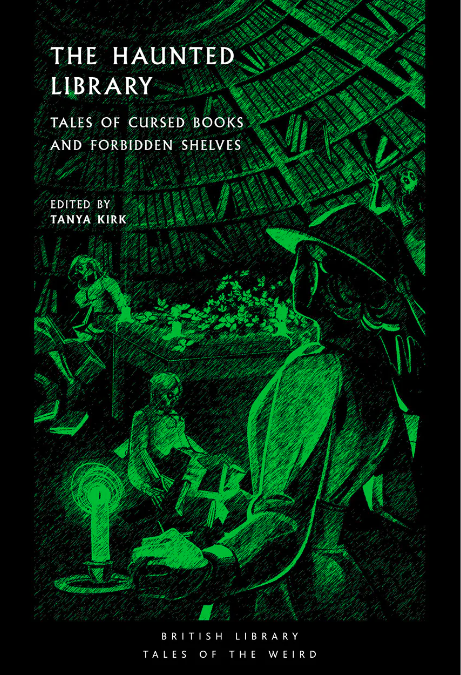
Tanya Kirk (ed.), The Haunted Library: Tales of Cursed Books and Forbidden Shelves (British Library Publishing, 2025), 251pp.
‘Often I feel that I must take the book in that safe and throw it into the middle of the sea,’ he continued, ‘But I can’t do it. I’m too afraid. Only one small book, but it is evil itself. That one book seizes a man by the throat and strangles him to death.’
– William Croft Dickinson, ‘The Work of Evil’ (1963)
It is perhaps a little surprising that the excellent and ever-expanding ‘Tales of the Weird’ series from British Library Publishing has taken so long to turn to the pleasingly self-referential subject of stories about haunted books and libraries, but thanks to Tanya Kirk we now have a collection dedicated to tales of unsettling volumes. Alongside the usual suspects such as M. R. James’s Tractate Middoth (although few of his stories don’t feature a haunted document in some way or another) and Algernon Blackwood, Kirk has included some wonderfully obscure stories (although I already knew several of them, since book-themed weird fiction is one of my particular interests). Two of my old favourites in this collection are ‘The Book’ (1930) by Margaret Irwin and A. N. L. Munby’s ‘Herodes Redivivus’ (1949). Both are deeply unsettling tales; Irwin’s story was one I came across by accident in another collection, and it is one of my favourite supernatural stories – featuring an evil, self-writing grimoire. Munby’s story I came across because I was interested in Munby himself (a former Rare Books Librarian at Cambridge University Library whose legacy in the UL is inescapable), so I read his collection The Alabaster Hand. The troubling ‘Herodes Redivivus’, which features a rare incunable by Gilles de Rez that has seemingly contributed to the corruption of a child-murderer, is easily the most memorable story in that collection.
Although by no means all of the stories here are antiquarian ghost stories (however we might define those), the antiquarian ghost story is arguably rooted in a fascination with the power of documents. James, in particular, seems to have longed to express the phenomenology of manuscript and bibliographical research in his ghost stories: what it feels like to read an ancient manuscript or early printed book – its power to evoke another world, a lost personality, a secret unread by anyone except you since it was first committed to parchment or paper. And alongside that natural fascination with all old books, there is also a lurking question about whether there are some especially powerful old books – the motive force behind the thriving occult book trade of the 18th and 19th centuries, for example. For many of the collectors who sought such books were not occultists and had no particular interest in magic, but the rarity of forbidden books was itself the attraction for them – or even the thought that maybe, just maybe, these books did contain some hidden power.
The question of the innate power of books is one that tends to be pondered by bibliographers, rare books librarians and book historians because these are the people who deal with books as physical objects – and objects of great beauty and historical resonance – in contrast to the vast mass of us who (unless we are book collectors) encounter books primarily as the vehicles for contents we want to consume. While I can’t be sure a haunted ebook, e-reader or PDF download is impossible, it certainly stretches the imagination (although in one of the stories, Penelope Lively’s ‘Revenant as Typewriter’ (1978), trashy magazines seemingly play a role in keeping a ghost alive). But there is undoubtedly something mystical about old books. I remember the eerie moment I came across an enormous early folio of the works of Abbot Trithemius (the abbot who inspired James’s ‘Treasure of Abbot Thomas’) in the library of a monastery, of all places – when I was the only person in the building. It was as if I was suddenly alone with the mysterious Abbot of Spanheim, reputedly the greatest magus of his age. Or the first time I opened a 16th-century manuscript grimoire, and saw the haunting faces drawn on some of some of the sigils.
Of course, in the real world I have never heard of a scholar who came a cropper in the same way as one of James’s unfortunate and hubristic protagonists, and in this respect the scholar who gets more than they bargained for from a book or manuscript is perhaps a metaphor or allegory for the ways in which scholars are undone by books. Some scholars are driven mad by crackpot theories, like the people who study the Voynich Manuscript. Some become insanely possessive of books and manuscripts and try to steal them, like the academic who is now permitted to work in a certain library only if he agrees to sit in a particular seat with a dedicated CCTV camera trained on him. Some collectors become obsessed with tracking down a particularly rare book. And, of course, the superior knowledge of some book historians simply infects them with the common human sins of arrogance and pride. But having said that, genuine Jamesian moments do happen – I remember a chilling moment in a lecture by a leading historian of medieval magic, when he described a spell so awful and repellent in an obscure manuscript he was reading that it left him feeling inwardly chilled and morally nauseated.
Alongside the theme of the haunted book, several of the stories in The Haunted Library deal with just that – haunted collections of books, from the library that literally eats people in Hester Holland’s ‘The Library’ (1933) to the book collection haunted by its former owner in Russell Kirk’s ‘What Shadows We Pursue’ (1953). If books are things of power, then libraries are indisputably places of uncanny power, humming with the potential of books as yet unread, treasurers as yet unfound and secrets yet undiscovered. If you have spent a lot of time in libraries you have surely dreamt of them; the libraries of my dreams have a certain familiarity, but they go on forever and the potential for discovery is boundless – boundless, and, by implication, including the potentially evil alongside the fascinating. Personal and private libraries have a further dimension; they express the personality of the person who collected them, which can therefore linger long after the person is dead. That can be true even of institutional libraries; in M. R. James’s study of the monastic library of Bury St Edmunds it feels as though Henry of Kirkstead, the 14th-century prior and librarian who devised a brilliant system of shelfmarks at the height of the Black Death, is a looming presence who imprinted – quite literally – his own mark on books that are now scattered across multiple collections. It is as if Henry’s library still somehow lives in some sphere of abstract bibliographical reality, regardless of whether it has been broken up. Personal libraries take a lifetime to assemble, and perhaps they do absorb and retain something of the life force of those who pour so much of themselves into them…
In any case, if the uncanniness of books and libraries intrigues you, Tanya Kirk’s The Haunted Library is an excellent place to start.

Leave a comment