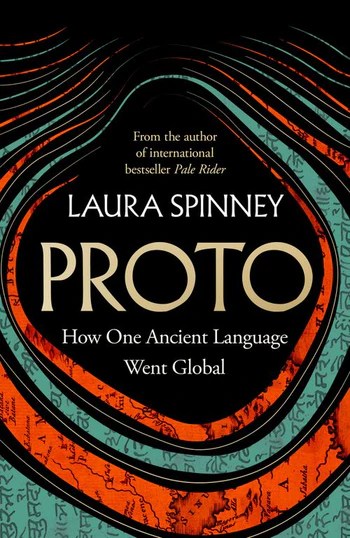
Proto by Laura Spinney was one of two well-publicised books about the Indo-Europeans that appeared in 2025, the other being J. P. Mallory’s The Indo-Europeans Rediscovered. According to Amazon, both of these books are ‘frequently bought together’ with my Silence of the Gods, so I thought I should try to read at least one of them. I settled on Spinney’s Proto, which is a good introduction to Proto-Indo-European and the story of the Indo-European languages for the general reader, including the latest insights and research breakthroughs. I should confess that I have something of a history of being a sceptic when it comes to Indo-European studies; I am fascinated, like most people, by the reconstruction of Proto-Indo-European as a linguistic phenomenon (and a remarkable monument in the history of the discipline of linguistics). Not being an expert in linguistics, I cannot comment on how well or plausibly Indo-European has been reconstructed. The viability of the identification of the speakers of Proto-Indo-European with the Yamnaya culture is, likewise, something I do not have the expertise in archaeology or archaeogenetics to judge. But when it comes to the idea that the conceptual world – and especially the religious outlook – of the first Indo-Europeans/Yamnaya can be reassembled from their reconstructed language, I am afraid I reach for my red ballpoint pen.
I know people are utterly captivated by the thought that at least one prehistoric language of a Neolithic and Bronze Age people can be reconstructed as they actually spoke it. It is perfectly natural that readers should be equally captivated by the idea that the language somehow gives access to the mental and conceptual world of those prehistoric people. It makes for a great story, seemingly bringing prehistoric voices into history in the way the mute witness of archaeology on its can never allow. Spinney’s book would be a lot less interesting, and a lot less readable, if she set aside the theories about beliefs and societies built on top of Indo-European linguistics. Nevertheless, being the party-pooper that I am, I remain deeply sceptical that we can know anything with certainty about the conceptual world of the Proto-Indo-Europeans, whoever they were. I blame Jacob Grimm, who was a brilliant linguist and believed the same philological methods applied to language to trace its origins could also be applied to mythology and folklore. The idea of a ‘tree of story’ became the dominant idea at the heart of the nascent discipline of folklore, according to which the diffusion of all tale-types, tropes and legends can potentially be reconstructed by studying their distribution.
I am a rather heretical folklorist because I reject this idea. Diffusionism, the idea that beliefs and stories are found in a society because they came there from somewhere else (and, ultimately, from some original homeland) is in my view a fundamentally misconceived way of looking at the world. Peoples of the past (deep or otherwise) were not the helpless recipients of diffused mythologies and religious traditions, and yet it was convenient for the 19th- and 20th-century folklorists to imagine them as such. The possibility of creativity, of the trickster storyteller who follows none of the rules (perhaps we could call it the ‘Ruth Tongue factor’?) was too difficult to acknowledge because it risked breaking the sacred thread that ensured continuity between diffused cultures and diffused stories over vast reaches of time. But in reality stories have no such sacredness or unbreachable integrity. Humans simply like telling stories; stories with the same narrative feel – with strong heroes, challenges to be overcome, narratively satisfying resolutions and so on – probably appeal to humans everywhere. But if we come across a story about a hero vanquishing a serpent or dragon-like monster, that doesn’t mean that all stories of heroes vanquishing serpents have a common source and origin. Ockham’s Razor comes into play; it isn’t the simplest explanation (that accounts for the facts) to suppose that a serpent-slaying myth was diffused from a single source, because there is nothing intrinsically improbable about multiple societies in multiple locations simultaneously creating a serpent-slaying myth. People everywhere like heroes, lots of people dislike snakes, the thought of a giant snake (why not also make it fly?) is a fairly obvious monster to scare people with.
A central figure in Spinney’s story of Proto-Indo-European (and rightly so) is Marija Gimbutas, who Spinney notes has been at least partially vindicated in her insistence that Indo-European came from the steppe and that the Kurgan-building Yamnaya were its speakers. However, we need to be a little cautious in rehabilitating Gimbutas, as what has not been vindicated is her belief that the Yamnaya brought a patriarchal religion of sky-gods that largely supplanted a pre-Indo-European matriarchal religion in ‘Old Europe’ – the evidence for the existence of matriarchal cults has not been forthcoming in the decades since she proposed it. Gimbutas is indeed a protean figure in Indo-European studies, to the extent that her work as a Balticist (and indeed her identity as a Lithuanian) sometimes gets overshadowed by her broader theories. Gratifyingly, Spinney does pay attention to Gimbutas’s book The Balts (1963) in her chapter on Baltic and Slavic, acknowledging that Gimbutas’s Lithuanianness did matter; after all, her Indo-Europeanism was inherited from the long tradition of philological fascination with Lithuania and its mythology that culminated in the 20th century with Wilhelm Mannhardt’s Letto-Preussische Götterlehre.
Proto’s chapter on Baltic and Slavic (which, you won’t be surprised to learn, was the chapter of most interest to me) is a good introduction to the current state of thinking on the history of these two sub-groups of the Indo-European family. The Balto-Slavic hypothesis is now more or less accepted by most linguists, but the surprisingly close relationship between the Baltic languages and Sanskrit remains puzzling. Older ideas of Lithuanian as an archaising Indo-European relic have been set aside, but the fact remains that the ancestors of Baltic-speakers (or Balto-Slavic-speakers) and the ancestors of Sanskrit-speakers seem to have interacted more closely than the mere fact of their kinship within the Indo-European family alone. It is possible that Sanskrit and Proto-Balto-Slavic diverged somewhere in the Dnipro basin, with the ancestors of Sanskrit-speakers embarking on a long trek to India while the Proto-Balts and Proto-Slavs hung around in Eastern Europe for centuries thereafter, before the Balts split off and headed north – with the Slavs only moving north and west many centuries later, where (as the ancestors of today’s Belarusians and Poles) they bumped up against the borders of their long-lost Baltic cousins.
Proto is an excellent survey of the interaction of linguistics and archaeogenetics and what it can achieve. That is quite impressive enough. What I wish we could finally bring ourselves to set aside is the idea of a pan-Indo-European mythology. Take what Spinney says about snakes, for example: the hero-killing-the-serpent myth, we are told, is an ancient Proto-Indo-European tale probably told by our most distant steppe ancestors. But this doesn’t account for the veneration of snakes among the Balts (and Spinney doesn’t even mention the Romans’ worship of the Lares as snakes, seemingly inherited from the Campanians), so that is explained away as an eccentric inversion of the traditional Indo-European attitude. But who is to say that the Balts did not preserve the original Indo-European attitude to snakes, which was a positive one? The reality is that mythologies do not give the sort of access to deep time that scholars crave. Language is indeed ancient, but as I demonstrated at length in Twilight of the Godlings (with respect to Britain) designations of divine and mythical beings are especially fluid as religious ideas evolve. As Spinney herself acknowledges, sometimes religious change is the best way to explain cultural peculiarities – such as the apparent egalitarianism of early inhabitants of Armenia, and the vast trek undertaken by the Tocharians from the Eastern European steppe to the Far East.
Yet elsewhere in the Indo-European world a sort of religious and mythological stasis is assumed, where words continue to be applied in the same way to the unseen realm over the longue durée. But as we see with the gods of the Mycenaeans, some names and titles associated with the later Olympians are found among them, but apparently referring to different (unknown) divine figures and playing different roles. In other words, the Homeric/Hesiodic Olympian pantheon is pretty much useless for interpreting the Mycenaean pantheon, and certainly the Olympians cannot be ‘reverse-engineered’ in any way that produces something like the Mycenaean pantheon. Over long periods of time, religion is a lot more fluid than most people want to believe; but a Frazerian-Jungian desire to believe that religion is ‘primitive’ and ‘archetypal’ (and therefore essentially very slow to change) persists. In sum, therefore, the Indo-European story is a fascinating adventure in linguistics and genetics. We have much to learn from it. But if you think the mythology and religion of the earliest Indo-Europeans/Yamnaya can be reconstructed from an examination of the lexicon of Proto-Indo-European, I might just have a bridge to sell you…

Leave a comment