
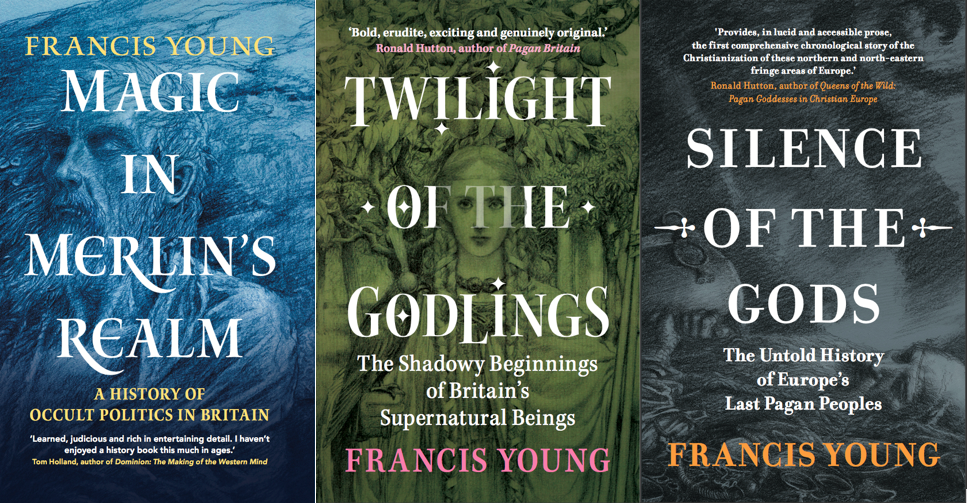
Today is publication day for my new book Silence of the Gods: The Untold History of Europe’s Last Pagan Peoples with Cambridge University Press. The book is a history of all the European peoples who were late adopters of Christianity, and retained their pre-Christian religious traditions for any length of time after 1387 (when Europe’s last ‘pagan’ country, Lithuania, officially converted). These peoples include the Lithuanians, Latvians and Prussians, the Estonians and Karelians, the Sámi, the Nenets, the Maris, Mordvins, Udmurts and Chuvashes, and the Guanches of the Canary Islands. However, the focus of the book is not so much on the historical problem of why these peoples – and not others – were so reluctant to identify with Christianity. Its focus is, rather, on trying to understand these peoples’ religious traditions in their own terms and to make sense of what ‘pre-Christian’ religion was in late medieval, early modern and modern Europe.
My aim in Silence of the Gods is to add a new dimension to the historiography of European religion, whose focus is usually on Christianity, Judaism and Islam (in their several varieties) as the religions of the continent since the end of antiquity. Pre-Christian religion seldom receives much attention; it is either treated as an ‘ethnic’ phenomenon highly specific to one particular country or region (like Sápmi or the Baltic states), or portrayed as a swiftly vanishing relic whose demise was inevitable in the face of the expanding and centralising claims of late medieval and early modern states. Silence of the Gods is the first book to examine pre-Christian traditions collectively in the period 1300-1900 as a factor in the European religious landscape, and my argument is that they were surprisingly significant – not necessarily because adherents of such traditions were numerous, but because their very existence caused considerable anxiety for confessional states, especially from the 16th century onwards.
However, a key conclusion of the book is that characterising Europe’s late adopters of Christianity as ‘pagans’ is not especially helpful. There was no such thing as a single ‘paganism’ that preceded the arrival of Christianity in these societies, and their religious traditions were very diverse. And although these societies declined to adopt Christianity, sometimes for centuries, that does not mean they did not interact with it, and relentless missionary activity resulted in cultural forgetting of many of these peoples’ original pre-Christian religious traditions. The result was that these peoples found themselves in a ‘religious no man’s land’, where they were simultaneously cut off from their own traditions and ignorant of Christianity. The result was the development of ‘creole religions’, self-fashioned community religions that were a bricolage of pre-Christian and Christian elements, and made use of sources of the sacred in the surrounding environment. Silence of the Gods thus offers a new way of understanding late pre-Christian religions in Europe as complex, creative and creolised constructions.
The immediate inspiration for Silence of Gods was a conference I attended in May 2023 at the University of Tromsø in Norway, which explored the work of the early modern German-Swedish ethnographer Johannes Schefferus in Sápmi. At that conference I spoke about early modern descriptions of Baltic pre-Christian religion (the subject of my 2022 book Pagans in the Early Modern Baltic), and I became conscious that a broader comparative study was needed to make sense of the persistence of pre-Christian religions in early modern Europe, since scholars of Sámi and Baltic religion did not really talk to one another. Silence of the Gods is the result.
However, this book is also the product of my longstanding interest in the broader question of the persistence of pre-Christian religion in Europe after antiquity – which was the subject of the book I co-wrote with Robin Douglas in 2024, Paganism Persisting. The focus of that book was on elite ‘pagan revivals’, however, rather than the kind of grassroots popular religion discussed in Silence of the Gods. As well as bringing to light instances of pagan persistence, Silence of the Gods is also an effort to pivot the discussion of late paganism in Europe eastwards and northwards, when discussions have often only been about ‘hidden’ or ‘underground’ paganism in medieval western Europe. It has long been a source of irritation to me that people cling to myths about a pagan Middle Ages that didn’t exist, when they are ignoring a pagan Middle Ages that did exist – it was just in regions that many people know little about.
While my own interest in the idea of pagan persistence began, as with so many other readers, with the scholarship of Ronald Hutton – back in 2011, when I became so engrossed in reading The Triumph of the Moon that I was run over by a motorbike in Cambridge – by 2019 I had come to realise that my experience of Lithuania and knowledge of the Lithuanian language (however rusty) from my undergraduate days put me in a uniquely advantageous position to begin exploring the history of a corner of Europe known for its late adoption of Christianity, but unknown to most Anglophone scholars: the Baltic. It was in late 2019 that I decided to make Baltic history one of the main focuses of my research agenda, resulting in two volumes of translations (Pagans in the Early Modern Baltic (2022) and Poetry and Nation-Building in the Grand Duchy of Lithuania (2024)) as well as Pre-Christian Baltic Religion and Belief (2025) – and now, Silence of the Gods. It is my hope that this book will bring the remarkable history of ‘pagan’ persistence in Eastern and Northern Europe – even if ‘pagan’ may not be exactly the right word for it – to light.

Leave a comment