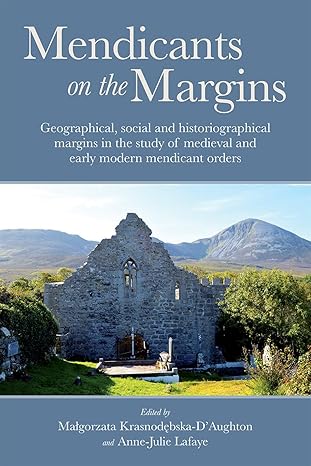
My chapter ‘Mendicant Missionary Journeys in Late Medieval and Early Modern Lithuania’ has just been published in Mendicants on the Margins, an edited collection based on a conference by University College Dublin in 2021, ‘Temporal journeys in late medieval and early modern Europe’. My chapter is based on the paper I delivered on that occasion.
Mendicant friars travelled to Lithuania from the middle of the 13th century onwards, beginning with the conversion of King Mindaugas to Christianity, and the mendicants had established a permanent presence in Lithuania by the reign of Grand Duke Gediminas. However, the purposes of mendicant missionary journeys to, from, and within Lithuania were complex, and the friars were not just concerned with the conversion of pagans to Christianity. Friars served as scribes and diplomats at the grand duke’s court, ministered to existing Christian communities, and sought to convert the Orthodox Ruthenians to Catholicism. While the friars occasionally came into conflict with the pagan authorities, resulting in martyrdoms in 1341 and 1369, the relationship between the grand dukes and the mendicants was largely one of interdependence and mutual usefulness. After Lithuania’s formal conversion, the friars remained important in the absence of developed parish organisation in the Lithuanian church.
This Lithuanian version of the chapter’s abstract was kindly translated by Saulė Kubiliūtė:
Misionieriškos elgetaujančių ordinų kelionės Viduramžių ir ankstyvųjų Naujųjų laikų Lietuvoje
Elgetaujantys vienuoliai į Lietuvą pradėjo keliauti nuo XIII a. vidurio, Karaliui Mindaugui priėmus krikštą, o įsitvirtino valdant Didžiajam Kunigaikščiui Gediminui. Vis dėlto tikslai šių misionieriškų kelionių į ir iš Lietuvos bei pačioje Lietuvoje buvo kompleksiški, ir vienuoliai rūpinosi ne tik pagonių atvertimu į krikščionybę. Jie taip pat pasitarnavo kaip didžiojo kunigaikščio raštininkai ir diplomatai, pagelbėdavo jau egzistuojančioms krikščionių bendruomenėms ir siekė atversti stačiatikybę išpažįstančius rusėnus į katalikybę. Nors retkarčiais vienuoliai ir sukonfliktuodavo su pagoniška valdžia (tokie konfliktai baigėsi kankinio mirtimis 1341 m. ir 1369 m.), santykiai tarp didžiųjų kunigaikščių ir elgetaujančių ordinų pasižymėjo nepriklausomybe ir abipuse nauda. Lietuvai oficialiai priėmus katalikybę, vienuoliai išliko svarbūs dėl neišvystyto Lietuvos Bažnyčios parapijų tinklo.

Leave a comment