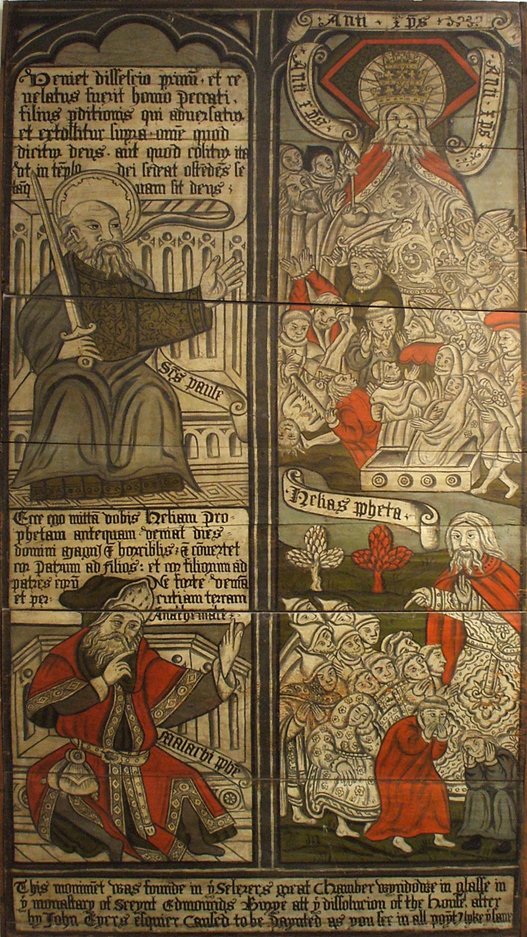
My article ‘A Monastic Antichrist Satire from Medieval Bury St Edmunds: Interpreting the Iconotypicon Buriense’ has just been published in the journal Downside Review. The article offers a new interpretation of an early modern copy of a medieval stained glass window depicting the Antichrist from St Edmunds Abbey, Bury St Edmunds.
The visitor to Moyse’s Hall Museum in Bury St Edmunds will encounter a curious painted panel dating from around 1560 which is apparently a life-sized copy of one of the lost stained glass windows of St Edmunds Abbey, painted before it was taken down after the dissolution. The window stood not in the Abbey church itself but in the Cellarer’s Chamber, which stood for several decades after the Abbey’s dissolution in 1539. This particular window seems to have been copied on account of some unusual imagery it contains; it portrays the reign of Antichrist, and presents Antichrist (in the top right hand corner) wearing a triple crown resembling a papal tiara. By the early years of the reign of Elizabeth I, when the idea that the Pope was Antichrist was an established tenet of Protestant belief, the appearance of such a triple crown in a fourteenth- or fifteenth-century window was a matter of considerable interest; it bolstered the idea promoted by the Protestant martyrologist John Foxe that Protestantism was not a new phenomenon, but that a holy remnant of godly Christians had always existed within the corrupt medieval Church and had resisted the degenerate papacy. For Protestants with this historiographical agenda, the image in the Cellarer’s Chamber window was an astonishing find and a key piece of evidence for the existence of medieval Protestants avant la lettre.
In the early 17th century the painting was viewed by the Norfolk antiquary Henry Spelman, who wrote about it to James Ussher, the celebrated scholar and Archbishop of Armagh. Indeed, Spelman wrote a Latin poem describing the painting entitled Iconotypicon Buriense, which for centuries remained the only source of information about the painting, which was lost until 1911 when it was rediscovered at Hardwick Hall, the home of the Cullum family. The Cullums were key benefactors of Moyse’s Hall Museum in Bury St Edmunds and the source of much of the museum’s core collection of artefacts from the Abbey, and thus the Iconotypicon (as the painting came to be called, after Spelman’s poem) found its way to the museum.
One of the antiquaries to take an interest in the newly rediscovered Iconotypicon was the great M. R. James, who had a particular interest in St Edmunds Abbey. James recognised that Spelman’s ideologically loaded interpretation of the Iconotypicon was far-fetched, but did not produce an alternative interpretation of why the Antichrist should be portrayed wearing a triple crown in a late medieval monastic window, and indeed why there should have been a portrayal of the Antichrist in the Cellarer’s Chamber.
My article reinterpreting the Iconotypicon is the first attempt to do so since its rediscovery in 1911, and is based on research I undertook on behalf of Moyse’s Hall Museum in 2022 for a new exhibition of artefacts from St Edmunds Abbey. While any interpretation of the Iconotypicon has to rely on the assumption that the early modern painting is a fairly accurate reproduction of a late medieval window, I argue that there are sufficient clues in the Iconotypicon to identify it as a religious satire advancing the monastic agenda of St Edmunds Abbey as a monastery jealous of its privileges against bishops and in constant conflict with the Franciscan friars at nearby Babwell Friary (the subject of my forthcoming volume with the Suffolk Records Society). In the Iconotypicon, a friar appears prominently in the entourage of Antichrist, preaching with a devil emerging from his mouth. This plausibly situates the Cellarer’s Chamber window within the context of late medieval ‘antifraternalism’, a movement of opposition to the mendicant friars who were sometimes portrayed as agents of Antichrist.
Antichrist’s triple crown is not in fact an allusion to the Pope as Antichrist; while there were Lollards in England who made such a claim at around the time the window was created, the idea that they could have influenced an expensive and elaborate window in a Benedictine abbey is implausible. Instead, the crowns worn by Antichrist originate in the antisemitic trope of the Judenhut, where Antichrist is shown wearing the pointed hat that medieval Jews were sometimes forced to wear. The addition of crowns to the Judenhut is rare iconographically, but was probably intended as a mockery of the papal tiara that signified the Pope’s universal dominion. The Antichrist is claiming a similar kind of sovereignty; and the papal schism of the late fourteenth century desacralised papal imagery and made it possible to portray the Antichrist wearing headgear that resembled a papal tiara. The Iconotypicon is thus a conservative work of art drawing on antisemitic and antifraternal imagery rather than a subversive proto-Protestant attack on the papacy.

Leave a comment